


Page 94 - Class-11-Physics-Part-1_Neat
P. 94
80 PHYSICS
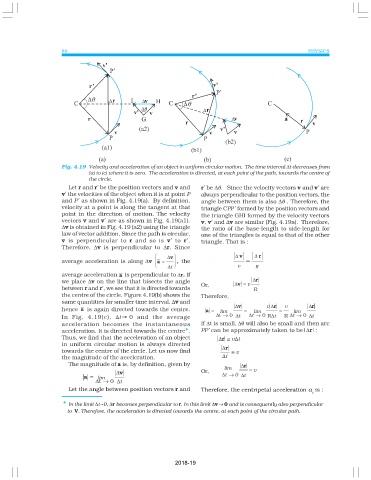
Fig. 4.19 Velocity and acceleration of an object in uniform circular motion. The time interval ∆t decreases from
(a) to (c) where it is zero. The acceleration is directed, at each point of the path, towards the centre of
the circle.
Let r and r′ be the position vectors and v and r′ be ∆θ. Since the velocity vectors v and v′ are
v′ the velocities of the object when it is at point P always perpendicular to the position vectors, the
and P′ as shown in Fig. 4.19(a). By definition, angle between them is also ∆θ . Therefore, the
velocity at a point is along the tangent at that triangle CPP′ formed by the position vectors and
point in the direction of motion. The velocity the triangle GHI formed by the velocity vectors
vectors v and v′ are as shown in Fig. 4.19(a1). v, v′ and ∆v are similar (Fig. 4.19a). Therefore,
∆v is obtained in Fig. 4.19 (a2) using the triangle the ratio of the base-length to side-length for
law of vector addition. Since the path is circular, one of the triangles is equal to that of the other
v is perpendicular to r and so is v′ to r′. triangle. That is :
Therefore, ∆v is perpendicular to ∆r. Since
∆ v ∆ v ∆ r
average acceleration is along ∆v a = , the =
∆t v R
average acceleration a is perpendicular to ∆r. If
we place ∆v on the line that bisects the angle ∆r
Or, ∆v = v
between r and r′, we see that it is directed towards R
the centre of the circle. Figure 4.19(b) shows the Therefore,
same quantities for smaller time interval. ∆v and
∆ v v ∆ r v ∆ r
hence a is again directed towards the centre. a = lim = lim = lim
In Fig. 4.19(c), ∆t 0 and the average ∆t → 0 ∆t ∆t → 0 R ∆t R ∆t → 0 ∆t
acceleration becomes the instantaneous If ∆t is small, ∆θ will also be small and then arc
acceleration. It is directed towards the centre*. PP′ can be approximately taken to be|∆r|:
Thus, we find that the acceleration of an object ∆r ≅ v ∆t
in uniform circular motion is always directed
∆r
towards the centre of the circle. Let us now find ≅ v
the magnitude of the acceleration. ∆t
The magnitude of a is, by definition, given by ∆r
lim =
∆ v Or, ∆t → v
a = lim 0 ∆t
∆t → 0 ∆t
Let the angle between position vectors r and Therefore, the centripetal acceleration a is :
c
* In the limit ∆t0, ∆r becomes perpendicular to r. In this limit ∆v→ 0 and is consequently also perpendicular
to V. Therefore, the acceleration is directed towards the centre, at each point of the circular path.
2018-19

