


Page 90 - Class-11-Physics-Part-1_Neat
P. 90
76                                                                                     PHYSICS

                                       = v  0 t +  1  t a  2            Given x (t) = 84 m, t = ?
                                           2                                               2
                                                                               5.0 t + 1.5 t  = 84 ⇒⇒ ⇒⇒ ⇒ t = 6 s
                                                                                            2
                                         1   2                          At t = 6 s,  y = 1.0 (6)  = 36.0 m
                       Or,  r =  r +  v t  +  at              (4.34a)
                                 0
                                     0
                                         2                                                    dr
                                                                                                            ) +
                                                                                                                    ˆ
                                                                         Now, the velocity  v  =  =  (5.0 +  3.0t i ˆ  2.0t j
                       It can be easily verified that the derivative of                       dt
                                       dr                               At  t = 6 s,   v = 23.0   i +12.0   j
                       Eq. (4.34a), i.e.    gives Eq.(4.33a) and it also
                                       dt
                                                                                         2
                                                                                              2
                       satisfies the condition that at  t=0, r  = r .   speed = v   =  23 + 12 ≅  26 m s − 1        t
                                                                   o                                      .
                       Equation (4.34a) can be written in component
                       form as                                          4.9    RELATIVE VELOCITY IN TWO
                                                                               DIMENSIONS
                                          1    2
                             x =  x + v t +  a t                        The concept of relative velocity, introduced in
                                      ox
                                             x
                                  0
                                          2                             section 3.7 for motion along a straight line, can
                                          1                             be easily extended to include motion in a plane
                             y =  y + v t +  a t  2           (4.34b)   or in three dimensions. Suppose that two objects
                                 0
                                      oy
                                          2  y
                                                                        A and B are moving with velocities v  and v  B
                                                                                                             A
                       One immediate interpretation of Eq.(4.34b) is that  (each with respect to some common frame of
                       the  motions in x- and y-directions can be treated  reference, say ground.). Then, velocity of object
                       independently of each other.  That is, motion in  A relative to that of B is :
                       a plane (two-dimensions) can be treated as two         v  = v – v                       (4.35a)
                       separate simultaneous one-dimensional                   AB   A   B
                       motions with constant acceleration along two     and similarly, the velocity of object B relative to
                       perpendicular directions.  This is an important  that of A is :
                       result and is useful in analysing motion of objects    v BA   =  v – v A
                                                                                     B
                       in two dimensions. A similar result holds for three  Therefore, v AB    = – v BA           (4.35b)
                       dimensions. The choice of perpendicular          and, v  AB  =  v BA                    (4.35c)
                       directions is convenient in many physical
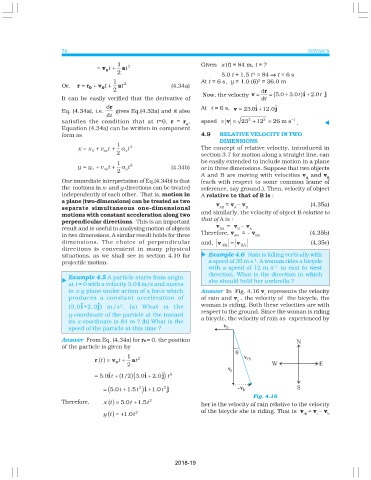
                       situations, as we shall see in section 4.10  for   t  Example 4.6   Rain is falling vertically with
                                                                                           –1
                       projectile motion.                                  a speed of 35 m s . A woman rides a bicycle
                                                                                                  –1
                                                                           with a speed of 12 m s  in east to west
                                                                           direction. What is the direction in which
                         Example 4.5 A particle starts from origin         she should hold her umbrella ?
                         at t = 0 with a velocity 5.0 î m/s and moves
                         t
                         in x-y plane under action of a force which     Answer  In  Fig. 4.16 v represents the velocity
                                                                                               r
                         produces a constant acceleration of            of rain and v , the velocity of  the bicycle, the
                                                                                     b
                              $ $ $ $ $
                                    $ $ $ $ $
                                            2
                         (3.0i+2.0j)   m/s . (a) What is the            woman is riding. Both these velocities are with
                                                                        respect to the ground. Since the woman is riding
                         y-coordinate of the particle at the instant    a bicycle, the velocity of rain as  experienced by
                         its x-coordinate is 84 m ? (b) What is the
                         speed of the particle at this time ?
                       Answer  From Eq. (4.34a) for r0= 0, the position

                       of the particle is given by
                                   r  ( ) t = v 0 t +  1  t a  2
                                              2
                                               )(
                                   = 5.0 t +  (1/2 3.0 +i ˆ  2.0j ˆ ) t 2
                                       ˆ
                                       i
                                                           2 ˆ
                                      =  (5.0t + 1.5t 2 ˆ  1.0t j
                                                   ) +i
                                                                                           Fig. 4.16
                       Therefore,     x  ( ) t =  5.0t + 1.5t 2         her is the velocity of rain relative to the velocity
                                      y  ( ) t = + 1.0t 2               of the bicycle she is riding. That is  v = v – v b
                                                                                                                 r
                                                                                                             rb
                                                               2018-19

