


Page 109 - Engineering Mathematics Workbook_Final
P. 109
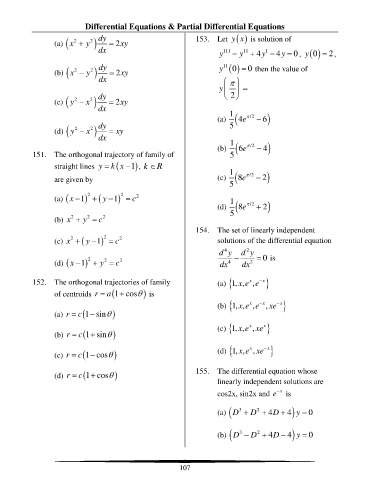
Differential Equations & Partial Differential Equations
y
(a) ( x + 2 y 2 ) dy = 2xy 153. Let ( ) x is solution of
dx y 111 − y + 4y − 4y = , ( ) 0 = ,
1
11
2
0 y
0
(b) ( x − 2 y 2 ) dy = 2xy y 11 ( ) 0 = then the value of
dx
y 2 =
(c) ( y − 2 x 2 ) dy = 2xy
dx 1
(a) (4e /2 − ) 6
(d) ( y − 2 x 2 ) dy = xy 5
dx 1
(b) (6e /2 − ) 4
151. The orthogonal trajectory of family of 5
straight lines y = ( k x − ) 1 , k 1
R
are given by (c) (8e /2 − ) 2
5
2
2
2
(a) (x − ) 1 + ( y − ) 1 = c 1
(d) (8e /2 + ) 2
5
2
(b) x + 2 y = 2 c
154. The set of linearly independent
2
2
2
(c) x + ( y − ) 1 = c solutions of the differential equation
4
2
d y − d y =
2
2
2
(d) (x − ) 1 + y = c dx 4 dx 2 0 is
152. The orthogonal trajectories of family (a) 1, , ,e − x
x
x e
)
of centroids r = a + (1 cos is
x
x e
(b) 1, , ,e − x ,xe − x
(a) r = c (1 sin− )
x
x e
(c) 1, , ,xe x
(b) r = c (1 sin+ )
x
x e
)
(c) r = c − (1 cos (d) 1, , ,xe − x
)
(d) r = c + (1 cos 155. The differential equation whose
linearly independent solutions are
−
x
cos2x, sin2x and e is
3
2
(a) ( D + D + 4D + ) 4 y = 0
3
2
0
(b) ( D − D + 4D − ) 4 y =
107

