


Page 106 - Engineering Mathematics Workbook_Final
P. 106
Differential Equations & Partial Differential Equations
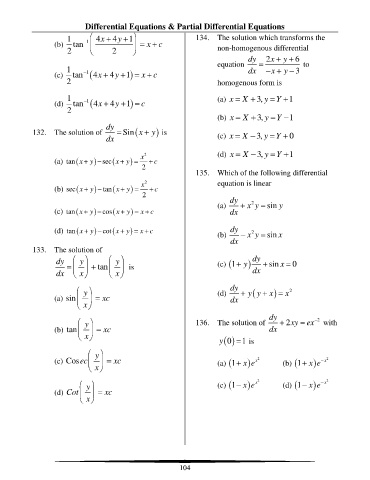
1 4x + 4y + 1 134. The solution which transforms the
+
(b) tan − 1 = x c
2 2 non-homogenous differential
dy 2x + y + 6
equation = to
1 dx − x + − 3
y
+
(c) tan − 1 (4x + 4y + ) 1 = x c
2 homogenous form is
1 (a) x = X + 3, y Y + 1
=
c
(d) tan − 1 (4x + 4y + ) 1 =
2
=
(b) x = X + 3, y Y − 1
dy
132. The solution of = Sin (x + ) y is (c) x = X − 3, y Y +
=
dx 0
=
( +
) sec x y =
(a) tan x y − ( + ) x 2 + c (d) x = X − 3, y Y + 1
2
135. Which of the following differential
) tan x y =
(b) sec x y − ( + ) x 2 + c equation is linear
( +
2 dy
(a) + x y = 2 sin y
(
(c) tan x + y − ( ) y = + dx
) cos x +
x c
(
(d) tan x + y − ( ) y = + (b) dy − x y = 2 sin x
) cot x +
x c
dx
133. The solution of
y
y
dy = + tan is (c) (1 y ) dy + sin x =
+
0
x
x
dx dx
y (d) dy + ( y y + ) x = x
2
(a) sin = xc dx
x
dy
=
−
y 136. The solution of + 2xy ex with
2
(b) tan = xc dx
x y ( ) 0 = is
1
y
(c) Cosec = xc (a) (1 x e+ ) x 2 (b) (1 x e+ ) − x 2
x
)
y (c) (1 x e− ) x 2 (d) (1 x e − x 2
−
(d) Cot = xc
x
104

