


Page 130 - Engineering Mathematics Workbook_Final
P. 130
Differential Equations & Partial Differential Equations
x ay (a) The value of u(2, 2) = -1
(a) z = + + b
a x
(b) The value of u(2, 2) = 1
x ay
(b) z = + + b 1 1 1
b x (c) The value of u , =
2 2 2
2
b
(c) z = ( 4 ax + ) y + 1 1 1
(d) The value of u , =
2
−
(d) (z b ) = ( 4 ax + ) y 2 2 2
Partial Differential Equations
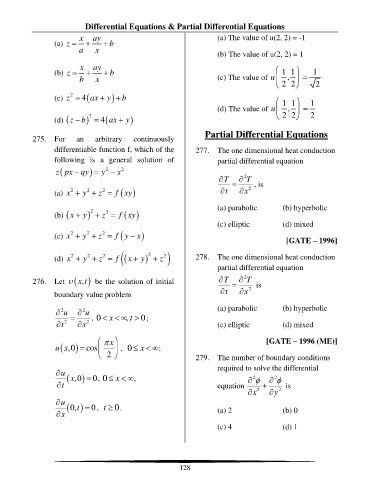
275. For an arbitrary continuously
differentiable function f, which of the 277. The one dimensional heat conduction
following is a general solution of partial differential equation
)
−
( z px qy = y − x 2
2
2
T = T , is
2
2
2
(a) x + y + z = f xy t x 2
( )
(a) parabolic (b) hyperbolic
(b) (x + ) y 2 + z = f xy
2
( )
(c) elliptic (d) mixed
2
2
2
(c) x + y + z = ( f y x− )
[GATE – 1996]
(d) x + y + z = f ( ( x + ) y 2 + z 2 ) 278. The one dimensional heat conduction
2
2
2
partial differential equation
, x
276. Let ( ) t be the solution of initial T = 2 T is
t x 2
boundary value problem
2 u 2 u (a) parabolic (b) hyperbolic
0
, t
= , 0 x ;
t 2 x 2 (c) elliptic (d) mixed
x [GATE – 1996 (ME)]
u ( ,0x ) cos= , 0 x ;
2 279. The number of boundary conditions
required to solve the differential
u
x
( ,0 = 2 2
) 0, 0 x ,
t equation + is
x 2 y 2
u ( ) 0t = , t 0.
0,
x (a) 2 (b) 0
(c) 4 (d) 1
128

