Page 129 - Engineering Mathematics Workbook_Final
P. 129
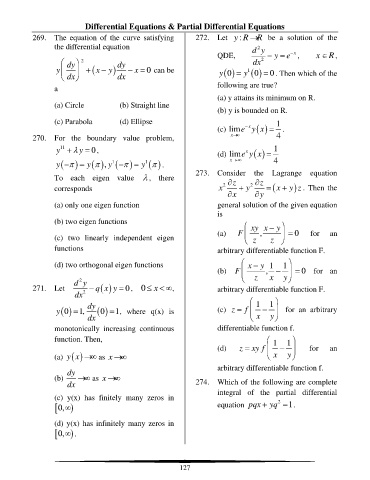
Differential Equations & Partial Differential Equations
                                                                                : →
            269.  The  equation  of  the  curve  satisfying       272.  Let  y R R   be  a  solution  of  the
                   the differential equation                                        d y
                                                                                      2
                                                                                                           
                                                                                              =
                                                                                                 −
                                                                                                  x
                                                                         QDE,            −  y e ,         x R ,
                       dy   2         dy                                           dx 2
                    y            + (x −  ) y  −  x =  0 can be      y ( ) 0 =  y 1 ( ) 0 =  0 . Then which of the
                       dx             dx
                   a                                                     following are true?
                                                                         (a) y attains its minimum on R.
                   (a) Circle            (b) Straight line
                                                                         (b) y is bounded on R.
                   (c) Parabola          (d) Ellipse                                        1
                                                                                      ( )
                                                                                  −
                                                                                   x
                                                                         (c) lime y x =       .
            270.  For  the  boundary  value  problem,                        x→            4
                    y +  11   y =  0 ,                                  (d) lime y x =     1
                                                                                     ( )
                                                                                  x
                          )
                                            )
                               ( ), y −
                                                 1
                     ( y  =  y      1 (  =   y                           x→−           4
                      −
                                                  ( ) .
                                                                  273.  Consider  the  Lagrange  equation
                   To  each  eigen  value   ,  there                         z       z 
                   corresponds                                           x 2    +  y 2   = (x +   ) y z .  Then  the
                                                                              x       y
                   (a) only one eigen function                           general solution of the given equation
                                                                         is
                   (b) two eigen functions                                          xy x −  y 
                                                                         (a)    F     ,            = 0    for   an
                   (c)  two  linearly  independent  eigen                           z     z  
                   functions                                             arbitrary differentiable function F.


                   (d) two orthogonal eigen functions                                x −  y  1  1   
                                                                         (b)  F        , −        =  0  for  an
                           2
                          d y                                                       z    x    y 
                                                  
            271.  Let          −  q ( ) x y =  0,  0 x ,               arbitrary differentiable function F.
                          dx 2
                              dy                                                        1  1   
                    y ( ) 0 =  1,  ( ) 0 =  1,  where  q(x)  is          (c)  z =  f      −        for  an  arbitrary
                              dx                                                      x  y 

                   monotonically  increasing  continuous                 differentiable function f.
                   function. Then,                                                         1   1 
                                                                         (d)    z =  xy f        −           for   an
                       y
                   (a)  ( ) x →   as  x →                                                x   y 
                                                                         arbitrary differentiable function f.
                       dy
                   (b)     →   as  x → 
                       dx                                         274.  Which of the following are complete
                                                                         integral  of  the  partial  differential
                   (c)  y(x)  has  finitely  many  zeros  in                                 2
                        )
                   0,                                                  equation  pqx +  yq =  1.

                   (d) y(x) has infinitely many zeros in
                        )
                   0, .


                                                            127
   124   125   126   127   128   129   130   131   132   133   134