Page 132 - Engineering Mathematics Workbook_Final
P. 132
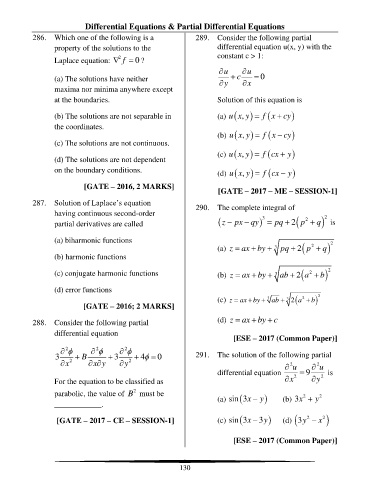
Differential Equations & Partial Differential Equations

            286.  Which one of the following is a                 289.  Consider the following partial
                   property of the solutions to the                      differential equation u(x, y) with the
                   Laplace equation:   2 f =  0 ?                       constant c > 1:

                                                                           u      u
                   (a) The solutions have neither                           y  +  c    x  =  0

                   maxima nor minima anywhere except
                   at the boundaries.                                    Solution of this equation is

                   (b) The solutions are not separable in                (a)  ( ,u x y =  )  ( f x cy+  )
                   the coordinates.
                                                                                                  )
                                                                                             −
                                                                             u
                                                                         (b)  ( , x y =  )  ( f x cy
                   (c) The solutions are not continuous.
                                                                             u
                                                                         (c)  ( , x y =  )  ( f cx +  ) y
                   (d) The solutions are not dependent
                   on the boundary conditions.                           (d)  ( , x y =  )  ( f cx −  ) y
                                                                             u

                             [GATE – 2016, 2 MARKS]
                                                                         [GATE – 2017 – ME – SESSION-1]
            287.  Solution of Laplace’s equation                  290.  The complete integral of
                   having continuous second-order                                       3                   2
                                                                                  −
                                                                                                      2
                   partial derivatives are called                        (z −  px qy   ) =  pq +   ( 2 p +  ) q  is
                   (a) biharmonic functions                                                                   2
                                                                                    +
                                                                                                        2
                                                                         (a)  z =  ax by +  3  pq +  ( 2 p +  ) q
                   (b) harmonic functions

                                                                                    +
                   (c) conjugate harmonic functions                      (b)  z =  ax by +  3  ab +  ( 2 a +  ) b  2
                                                                                                       2
                   (d) error functions
                                                                         (c)  z =  ax by +  3  ab +  3  ( 2 a +  ) b  2
                                                                                   +
                                                                                                     2
                             [GATE – 2016; 2 MARKS]
                                                                               =
                                                                                    +
                                                                                          +
            288.  Consider the following partial                         (d)  z ax by c
                   differential equation
                                                                              [ESE – 2017 (Common Paper)]
                       2       2      2 
                                                     0
                   3      +  B       + 3     +  4 =              291.  The solution of the following partial
                                 
                      x 2     x y       y 2                                                   2 u     2 u
                                                                         differential equation    2  = 9   2   is
                   For the equation to be classified as                                          x       y
                                             2
                   parabolic, the value of  B  must be                   (a) sin (3x −         (b) 3x +    2
                                                                                                     2
                   ____________.                                                         ) y             y

                                                                                                       2
                    [GATE – 2017 – CE – SESSION-1]                       (c) sin (3x − 3y )    (d) (3y −  x 2 )

                                                                              [ESE – 2017 (Common Paper)]


                                                            130
   127   128   129   130   131   132   133   134   135   136   137