Page 137 - Engineering Mathematics Workbook_Final
P. 137
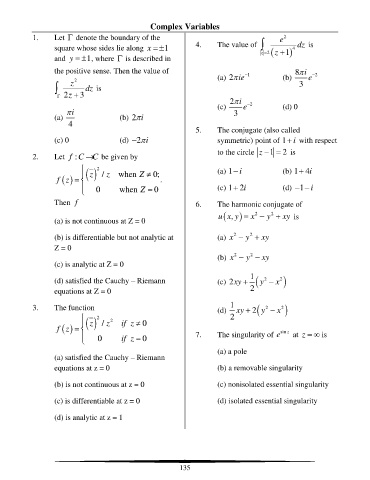
Complex Variables

            1.     Let  denote the boundary of the                                           e 2
                   square whose sides lie along  x =   1         4.     The value of     (z +  ) 1  4  dz  is
                                                                                       z =
                   and  y =   1, where  is described in                                2

                   the positive sense. Then the value of                 (a) 2 ie              (b)  8 i   e
                                                                                                        −
                                                                                  −
                                                                              
                                                                                   1
                                                                                                         2
                       z 2  dz  is                                                                 3
                      2z + 3                                                2 i 
                                                                                   −
                                                                                    2
                                                                         (c)     e             (d) 0
                         i                                                   3
                   (a)                   (b) 2 i 
                        4
                                                                  5.     The conjugate (also called
                                             −
                                                                                                +
                   (c) 0                 (d)  2 i                       symmetric) point of 1 i  with respect
                                                                         to the circle  z −  1 =  2  is
                             →
            2.     Let  : f C C be given by
                             ( ) 2                                      (a) 1 i −             (b) 1 4i
                                                                                                    +
                            
                            
                    f  ( ) z =   z  / z  when Z   0; .
                                                                             +                (d)  1 i −
                                                                                                   −
                                0       when Z =   0                    (c) 1 2i
                            
                   Then  f                                        6.     The harmonic conjugate of
                                                                                )
                                                                                     2
                                                                                           2
                                                                         u ( , x y =  x −  y +  xy  is
                   (a) is not continuous at Z = 0
                   (b) is differentiable but not analytic at             (a)  x −  2  y +  2  xy
                   Z = 0
                                                                         (b)  x −  2  y −  2  xy
                   (c) is analytic at Z = 0
                                                                                    1
                   (d) satisfied the Cauchy – Riemann                    (c) 2xy +    ( y −  2  x 2 )
                   equations at Z = 0                                               2

            3.     The function                                          (d)  xy +  1  ( 2 y −  2  x 2 )
                             ( ) 2   2                                      2
                            
                            
                    f  ( ) z =   z  / z  if z   0
                                                                 7.     The singularity of e sin z   at  z =   is
                                0       if z =  0
                            
                                                                         (a) a pole
                   (a) satisfied the Cauchy – Riemann
                   equations at z = 0                                    (b) a removable singularity

                   (b) is not continuous at z = 0                        (c) nonisolated essential singularity


                   (c) is differentiable at z = 0                        (d) isolated essential singularity

                   (d) is analytic at z = 1


                                                            135
   132   133   134   135   136   137   138   139   140   141   142