


Page 211 - Engineering Mathematics Workbook_Final
P. 211
Numerical Methods
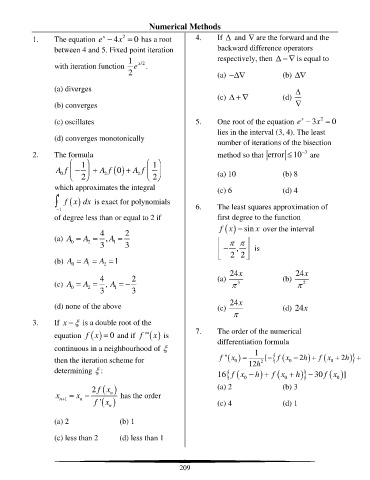
1. The equation e − x 4x = 2 0 has a root 4. If and are the forward and the
between 4 and 5. Fixed point iteration backward difference operators
1 respectively, then − is equal to
with iteration function e x /2 .
2 (a) − (b)
(a) diverges
(c) + (d)
(b) converges
(c) oscillates 5. One root of the equation e − x 3x = 2 0
lies in the interval (3, 4). The least
(d) converges monotonically
number of iterations of the bisection
−
3
2. The formula method so that error 10 are
1
1
A f − + A f ( ) 0 + A f
2
0
2
2 2 (a) 10 (b) 8
which approximates the integral (c) 6 (d) 4
1 f ( ) x dx is exact for polynomials
− 1 6. The least squares approximation of
of degree less than or equal to 2 if first degree to the function
f x =
( ) sin x over the interval
4 2
(a) A = A = , A =
2
0
3 1 3 − ,
2 2 is
(b) A = A = A = 1
1
0
2
24x 24x
4 2 (a) (b)
(c) A = A = , A = − 3 2
0 2 1
3 3
24x
(d) none of the above (c) (d) 24x
3. If x = is a double root of the
( )
f x =
f
equation ( ) 0 and if ''' x is 7. The order of the numerical
differentiation formula
continuous in a neighbourhood of 1
x
then the iteration scheme for '' f ( ) = 12h 2 [− ( f x − 2h ) + ( f x + 2h ) +
0
0
0
determining : 16 ( f x − ) h + ( f x + h ) 30 f− ( )]x 0
0
0
( )
2 f x (a) 2 (b) 3
x n+ = x − n has the order
( )
n
1
' f x n (c) 4 (d) 1
(a) 2 (b) 1
(c) less than 2 (d) less than 1
209

