


Page 213 - Engineering Mathematics Workbook_Final
P. 213
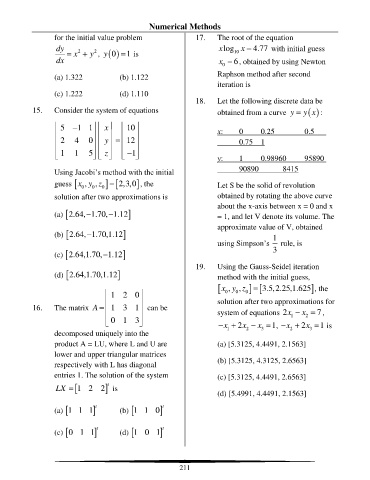
Numerical Methods
for the initial value problem 17. The root of the equation
dy = x + 2 y , ( ) 0 = is x log x = 4.77 with initial guess
2
10
1
y
dx x = 6, obtained by using Newton
0
(a) 1.322 (b) 1.122 Raphson method after second
iteration is
(c) 1.222 (d) 1.110
18. Let the following discrete data be
15. Consider the system of equations obtained from a curve y = y ( ) x :
5 − 1 1 10
x
x: 0 0.25 0.5
y =
2 4 0 12 0.75 1
1 1 5 − 1 y: 1 0.98960 95890
z
Using Jacobi’s method with the initial 90890 8415
guess , y z = Let S be the solid of revolution
,
x
2,3,0 , the
0 0 0
solution after two approximations is obtained by rotating the above curve
about the x-axis between x = 0 and x
−
−
(a) 2.64, 1.70, 1.12 = 1, and let V denote its volume. The
approximate value of V, obtained
−
(b) 2.64, 1.70,1.12 1
using Simpson’s rule, is
−
(c) 2.64,1.70, 1.12 3
19. Using the Gauss-Seidel iteration
(d) 2.64,1.70,1.12 method with the initial guess,
, y z =
,
x
3.5,2.25,1.625 , the
1 2 0 0 0 0
solution after two approximations for
16. The matrix A = 1 3 1 can be
system of equations 2x − x = 7,
0 1 3 − x + 2x − x = 1, x + 2x =
1
2
−
decomposed uniquely into the 1 2 3 2 3 1 is
product A = LU, where L and U are (a) [5.3125, 4.4491, 2.1563]
lower and upper triangular matrices
respectively with L has diagonal (b) [5.3125, 4.3125, 2.6563]
entries 1. The solution of the system (c) [5.3125, 4.4491, 2.6563]
t
LX = 1 2 2 is
(d) [5.4991, 4.4491, 2.1563]
t
(a) 1 1 1 (b) 1 1 0 t
t
t
(c) 0 1 1 (d) 1 0 1
211

