


Page 214 - Engineering Mathematics Workbook_Final
P. 214
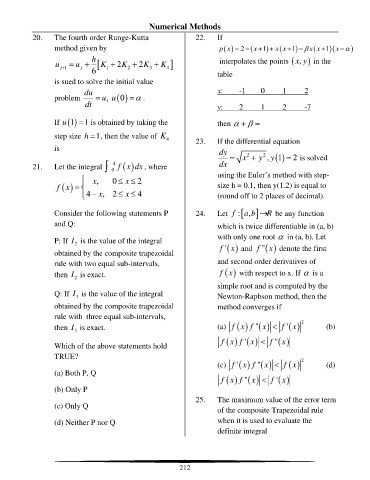
Numerical Methods
20. The fourth order Runge-Kutta 22. If
method given by p ( ) x = − ( x + ) 1 + ( x x + ) 1 − ( x x + 1 )(x − )
2
)
h interpolates the points ( , x y in the
u = u + K + 2K + 2K + K
j+
j
1
6 1 2 3 4 table
is sued to solve the initial value
du x: -1 0 1 2
problem = , u u ( ) 0 = .
dt y: 2 1 2 -7
u
If ( ) 1 = 1 is obtained by taking the then + =
step size h = 1, then the value of K 23. If the differential equation
4
is
dy = x + y 2 , y ( ) 1 = 2 is solved
2
21. Let the integral 0 4 f ( ) x dx , where dx
, x 0 x 2 using the Euler’s method with step-
f ( ) x = size h = 0.1, then y(1.2) is equal to
4 x , 2 4 (round off to 2 places of decimal).
−
x
R
f
Consider the following statements P 24. Let : , a b → be any function
and Q: which is twice differentiable in (a, b)
with only one root in (a, b). Let
P: If I is the value of the integral
2 ' f '' f
obtained by the composite trapezoidal ( ) x and ( ) x denote the first
rule with two equal sub-intervals, and second order derivatives of
then I is exact. f ( ) x with respect to x. If is a
2
simple root and is computed by the
Q: If I is the value of the integral Newton-Raphson method, then the
3
obtained by the composite trapezoidal method converges if
rule with three equal sub-intervals,
f x
'' f
then I is exact. (a) ( ) ( ) x ' f ( ) x 2 (b)
3
( ) ( ) x
f x ' f '' f ( ) x
Which of the above statements hold
TRUE? 2
x
'' f
' f
(c) ( ) ( ) x f ( ) x (d)
(a) Both P, Q
( ) ( ) x
f x '' f ' f ( ) x
(b) Only P
25. The maximum value of the error term
(c) Only Q
of the composite Trapezoidal rule
(d) Neither P nor Q when it is used to evaluate the
definite integral
212

