Page 215 - Engineering Mathematics Workbook_Final
P. 215
Numerical Methods
                     0.2 (sin x − log e  ) x dx with 12 sub-            (d) an infinite number of solutions
                      1.4

                   intervals of equal length, is equal to         28.    Solution of the variables  x  and  x
                   (round off to 3 places of decimal).                                               1      2
                                                                         for the following equations is to be
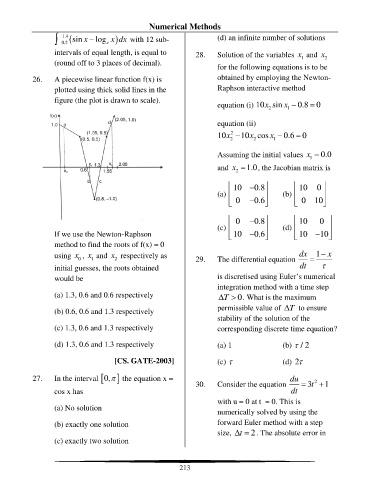
            26.    A piecewise linear function f(x) is                   obtained by employing the Newton-

                   plotted using thick solid lines in the                Raphson interactive method
                   figure (the plot is drawn to scale).
                                                                                                        =
                                                                                         x
                                                                         equation (i) 10 sin x −    0.8 0
                                                                                          2     1
                                                                         equation (ii)
                                                                         10x −   10 cos x −    0.6 0
                                                                                                   =
                                                                             2
                                                                                    x
                                                                                           1
                                                                             2
                                                                                     2
                                                                         Assuming the initial values  x =  0.0
                                                                                                        1
                                                                         and  x =  1.0, the Jacobian matrix is
                                                                               2
                                                                               10 − 0.8           10   0 
                                                                         (a)                  (b)        
                                                                                 0  − 0.6         0  10  


                                                                               0   − 0.8          10    0  
                                                                         (c)                  (d)         
                   If we use the Newton-Raphson                                  10 − 0.6         10 − 10  

                   method to find the roots of f(x) = 0
                                                                                                           −
                   using  x ,  x  and  x  respectively as         29.    The differential equation   dx  =  1 x
                           0
                               1
                                       2
                   initial guesses, the roots obtained                                              dt     
                   would be                                              is discretised using Euler’s numerical
                                                                         integration method with a time step
                   (a) 1.3, 0.6 and 0.6 respectively                       T   0. What is the maximum
                                                                                               
                   (b) 0.6, 0.6 and 1.3 respectively                     permissible value of  T  to ensure
                                                                         stability of the solution of the
                   (c) 1.3, 0.6 and 1.3 respectively                     corresponding discrete time equation?

                                                                                                  
                   (d) 1.3, 0.6 and 1.3 respectively                     (a) 1                 (b)  / 2

                                       [CS. GATE-2003]                   (c)                  (d) 2
                                        
            27.    In the interval 0,  the equation x =                                        du
                                                                  30.    Consider the equation       =  3t +  2  1
                   cos x has                                                                     dt
                                                                         with u = 0 at t  = 0. This is
                   (a) No solution
                                                                         numerically solved by using the

                   (b) exactly one solution                              forward Euler method with a step
                                                                         size,  t  =  2. The absolute error in
                   (c) exactly two solution


                                                            213
   210   211   212   213   214   215   216   217   218   219   220