


Page 223 - Engineering Mathematics Workbook_Final
P. 223
Numerical Methods
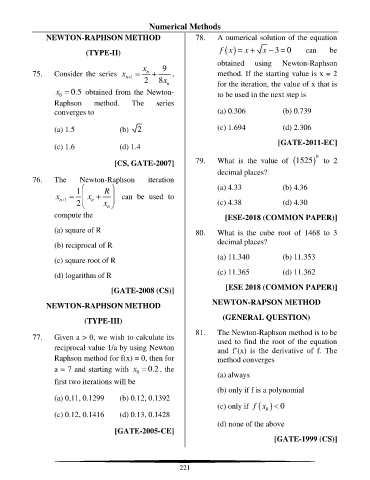
NEWTON-RAPHSON METHOD 78. A numerical solution of the equation
3 0
x
(TYPE-II) f ( ) x = + x − = can be
obtained using Newton-Raphson
x 9
75. Consider the series x n+ = n + , method. If the starting value is x = 2
1
2 8x n for the iteration, the value of x that is
x = 0.5 obtained from the Newton- to be used in the next step is
0
Raphson method. The series
converges to (a) 0.306 (b) 0.739
(a) 1.5 (b) 2 (c) 1.694 (d) 2.306
[GATE-2011-EC]
(c) 1.6 (d) 1.4
)
0
[CS, GATE-2007] 79. What is the value of (1525 to 2
decimal places?
76. The Newton-Raphson iteration
1 R (a) 4.33 (b) 4.36
x = x + can be used to
n+
1
2 n x n (c) 4.38 (d) 4.30
compute the [ESE-2018 (COMMON PAPER)]
(a) square of R 80. What is the cube root of 1468 to 3
(b) reciprocal of R decimal places?
(c) square root of R (a) 11.340 (b) 11.353
(d) logarithm of R (c) 11.365 (d) 11.362
[GATE-2008 (CS)] [ESE 2018 (COMMON PAPER)]
NEWTON-RAPHSON METHOD NEWTON-RAPSON METHOD
(TYPE-III) (GENERAL QUESTION)
81. The Newton-Raphson method is to be
77. Given a > 0, we wish to calculate its used to find the root of the equation
reciprocal value 1/a by using Newton and f’(x) is the derivative of f. The
Raphson method for f(x) = 0, then for method converges
a = 7 and starting with x = 0.2 , the (a) always
0
first two iterations will be
(b) only if f is a polynomial
(a) 0,11, 0.1299 (b) 0.12, 0.1392
(c) only if ( ) 0f x
0
(c) 0.12, 0.1416 (d) 0.13, 0.1428
(d) none of the above
[GATE-2005-CE]
[GATE-1999 (CS)]
221

