Page 55 - Engineering Mathematics Workbook_Final
P. 55
Vector Calculus
                       r                             r
                                           )
                                    $
                                         $
                              $
                                                                                2
                                                                           2
                                                                                    z
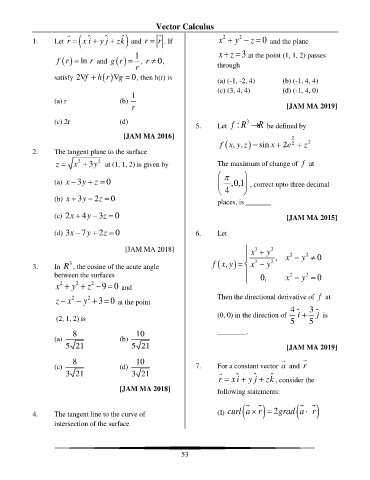
            1.     Let r = ( x i +  y j +  zk  and r =  r . If           x +   y − =    0  and the plane
                                              1                          x z +   3 =   at the point (1, 1, 2) passes
                    f r =             g         , r   0,
                      ( ) ln r  and  ( ) r =
                                              r                          through
                   satisfy 2 f  +  h ( ) r  = , then h(r) is           (a) (-1, -2, 4)       (b) (-1, 4, 4)
                                             0
                                        g
                                                                         (c) (3, 4, 4)         (d) (-1, 4, 0)
                                            1
                   (a) r                 (b)
                                             r                                                  [JAM MA 2019]
                   (c) 2r                (d)                                       3
                                                                                      R
                                                                  5.     Let  : f R →  be defined by
                                          [JAM MA 2016]                                           y
                                                                           ( , , y z =
                                                                                                       2
                                                                          f x      ) sin x +   2e +   z
                                                                                                  2
            2.     The tangent plane to the surface
                   z =   x +  2  3y  at (1, 1, 2) is given by            The maximum of change of  f  at
                                 2
                                                                                
                                                                                  
                              +
                   (a)  x − 3y z =  0                                        4  ,0,1 , correct upto three decimal
                                                                                  
                                                                                   
                                                                                  
                                                                         
                   (b)  x +  3y − 2z =  0                                places, is _______
                                       0
                   (c) 2x +  4y − 3z =                                                          [JAM MA 2015]
                                       0
                   (d) 3x − 7y +  2z =                            6.     Let
                                          [JAM MA 2018]                             x +  y 3  , x −  2  y   2  0
                                                                                     3
                                                                                  
                                                                                   
                                                                              )
                                                                                     2
                        3
            3.     In  R , the cosine of the acute angle               f  ( , x y =   x −  y 2
                                                                                  
                   between the surfaces                                               0,       x −  2  y =  2  0
                                                                                  
                                                                                  
                   x +   y +  z − =
                          2
                     2
                               2
                                   9 0  and
                     −
                   z x −     y + =                                       Then the directional derivative of  f  at
                         2
                              2
                                  3 0  at the point
                                                                                                 4  $  3  $
                                                                         (0, 0) in the direction of   i +  j  is
                    (2, 1, 2) is                                                                 5     5
                         8                    10                         ________.
                   (a)                   (b)
                       5 21                  5 21                                               [JAM MA 2019]
                         8                    10                                              r      r
                   (c)                   (d)                      7.     For a constant vector  a  and  r
                       3 21                  3 21                        r     $     $     $
                                                                         r =  x i +  y j +  zk , consider the
                                         [JAM MA 2018]                   following statements:
                                                                                  r r               r r
                                                                                                   (
                                                                                                      
                                                                            curl a r =
            4.     The tangent line to the curve of                      (I)  (        )   2grad a r     )
                   intersection of the surface


                                                             53
   50   51   52   53   54   55   56   57   58   59   60