Page 56 - Engineering Mathematics Workbook_Final
P. 56
Vector Calculus
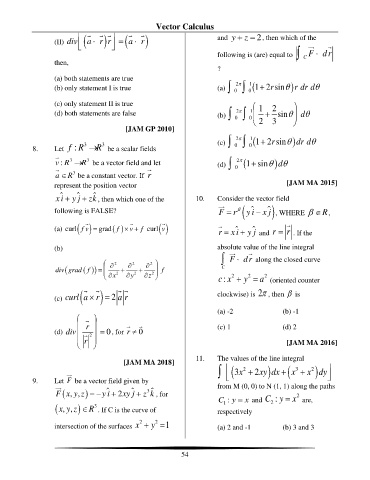
                             ( r r r    ( r r  )                       and  y +  z =  2, then which of the
                                
                                             
                                   ) 
                   (II) div  a r r =       a r
                                                                                                     ur     r
                                                                                                          
                                                                         following is (are) equal to   C   F dr
                   then,
                                                                         ?
                   (a) both statements are true                                2
                   (b) only statement I is true                          (a)   0   0   1 (1 2 sin+  r  )r dr d

                   (c) only statement II is true                                       1  2      
                   (d) both statements are false                         (b)   0   2  0  1   2  +  3 sin          d


                                           [JAM GP 2010]                       2   1            

                                   3
                             3
            8.     Let  : f R →  R  be a scalar fields                   (c)   0   0   (1 2 sin +  r  )dr d
                   r
                     : v R → R  be a vector field and let                (d)   0   2 (1 sin +  )d
                        3
                              3
                   r                              r
                   a  R  be a constant vector. If  r
                         3
                   represent the position vector                                                [JAM MA 2015]
                          $
                                $
                            +
                   x i +  $  y j zk , then which one of the       10.    Consider the vector field
                                                                         ur
                                                                                           )
                                                                                          $
                                                                                    $
                                                                                      −
                   following is FALSE?                                   F =  r   (  y i x j , WHERE   ,
                                                                                                            R
                                            r
                                                       r
                             r
                           ( )
                                                                                     $
                   (a) curl f v = grad ( ) f  +  f  curl v              r   x i +  $  y j  and r =  r
                                            v
                                                      ( )
                                                                         r =
                                                                                                r . If the
                   (b)                                                   absolute value of the line integral
                                                                             ur
                                                                                   r
                                                                            F   dr  along the closed curve
                                       2   2   2 
                   div ( grad f        +     +   2       f           C
                             ( )) = 
                                                                                         2
                                      x 2   y 2   z                   : c x +  2  y =  2  a  (oriented counter
                   (c)  (    r r  )     r r                              clockwise) is 2 , then   is
                               
                       curl a r =     2 a r
                                                                         (a) -2                (b) -1
                               r       r   r
                                               0
                   (d) div     r 2 r      =  0 , for r              (c) 1                 (d) 2
                              r   
                                                                                              [JAM MA 2016]
                                                                  11.    The values of the line integral
                                          [JAM MA 2018]                                                     
                                                                                                   3
                                                                                 2
                       ur                                                     (3x +  2xy ) dx + ( x +  x 2 ) dy  
            9.     Let F  be a vector field given by                                                        
                   ur                                                    from M (0, 0) to N (1, 1) along the paths
                             )
                                            $
                                                   $
                                    $
                                                  3
                   F  ( , ,x y z = − y i +  2xy j +  z k , for                                     2
                                                                                            : =
                                                                         C 1 : y =  x  and C y x  are,
                                                                                           2
                   ( , ,x y z ) R  3 . If C is the curve of             respectively
                   intersection of the surfaces  x +  2  y 2  1 =        (a) 2 and -1          (b) 3 and 3

                                                             54
   51   52   53   54   55   56   57   58   59   60   61