Page 59 - Engineering Mathematics Workbook_Final
P. 59
Vector Calculus

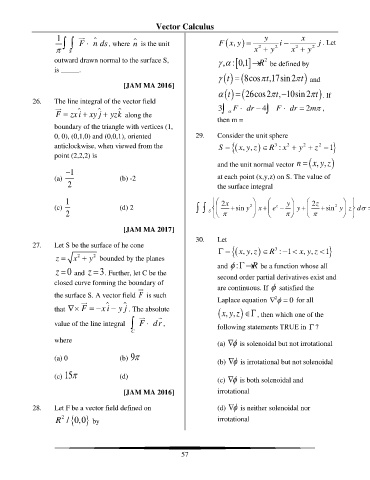
                    1    ur   $            $                           F  ( , x y =  )  y   i −    x    j . Let
                           F 
                       S       n ds , where  n  is the unit                         x +  2  y 2  x +  2  y 2

                   outward drawn normal to the surface S,                  , : 0,1 →    2
                                                                            
                                                                                 R  be defined by
                   is _____.
                                                                            t =
                                                                          ( ) (8cos ,17sin2 t       ) and
                                                                                         t 
                                          [JAM MA 2016]
                                                                          ( ) (26cos2 , 10sin2 t         ). If
                                                                            t =
                                                                                            t  −
            26.    The line integral of the vector field
                   ur                                                    3     F   dr −  4   F   dr =  2m ,
                                        $
                                 $
                           $
                            +
                   F =  zx i xy j +   yzk  along the
                                                                         then m =
                   boundary of the triangle with vertices (1,
                   0, 0), (0,1,0) and (0,0,1), oriented           29.    Consider the unit sphere
                                                                                      )
                   anticlockwise, when viewed from the                   S =   (  , , y z  R 3  : x +  y +  z =   1
                                                                                                     2
                                                                                                          2
                                                                                                2
                                                                                x
                   point (2,2,2) is
                                                                                                               )
                                                                         and the unit normal vector n = ( , , y z
                                                                                                         x
                        1 −
                   (a)                   (b) -2                          at each point (x,y,z) on S. The value of
                       2                                                 the surface integral
                       1                                                   2x               y      2z            
                                                                                                                2 
                                                                         
                                                                                            z
                                                                       
                                                                                                                     
                   (c)                   (d) 2                       S    + sin y 2   x +     e −      y +   + sin y z d =
                                                                                      
                                                                                                                    
                                                                                                       
                       2                                                                                    

                                          [JAM MA 2017]
                                                                  30.    Let
            27.    Let S be the surface of he cone
                                                                                      )
                                                                          =   (  , , y z  R 3  : 1 x y z    1
                                                                                               − 
                                                                                x
                                                                                                     , ,
                   z =   x +  2  y  bounded by the planes
                                2
                   z = 0 and z =  3. Further, let C be the               and  :   →  R be a function whose all
                   closed curve forming the boundary of                  second order partial derivatives exist and
                                               ur                        are continuous. If   satisfied the
                   the surface S. A vector field F  is such
                                                                                          
                            ur                                           Laplace equation   = 2  0 for all
                                    $
                                          $
                   that   F = −  x i −  y j . The absolute             ( , ,x y z   , then which one of the
                                                                                 )
                                               ur
                                                     r
                   value of the line integral     F   dr ,             following statements TRUE in  ?
                                            C
                   where
                                                                         (a)     is solenoidal but not irrotational
                   (a) 0                 (b) 9
                                                                         (b)     is irrotational but not solenoidal
                   (c) 15               (d)
                                                                         (c)     is both solenoidal and
                                          [JAM MA 2016]                  irrotational
            28.    Let F be a vector field defined on                    (d)    is neither solenoidal nor
                   R 2  / 0,0                                            irrotational
                          by

                                                             57
   54   55   56   57   58   59   60   61   62   63   64