Page 61 - Engineering Mathematics Workbook_Final
P. 61
Vector Calculus

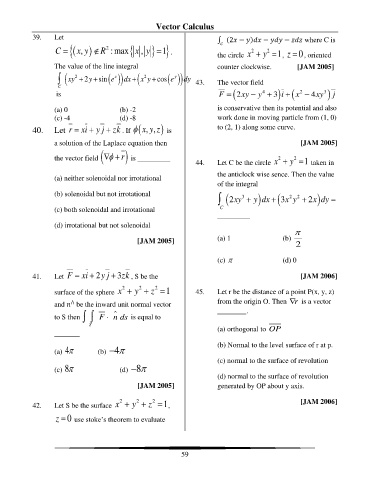
            39.    Let                                                   ∫ (2   −   )     −        −        where C is
                                                                            
                   C =   (   , x  ) y  R 2  :max  , x y = 1           the circle  x +  2  y 2  1 =  , z = , oriented
                                                                                                    0
                                                     .
                   The value of the line integral                        counter clockwise.            [JAM 2005]
                                     ( ))
                                                         ( ))
                      (   xy + 2y + sin e x  dx + ( x y + cos e y  dy
                                                 2
                          2
                    C                                             43.    The vector field
                                                                                             ) ( x −
                                                                                        4
                    is                                                   F =  ( 2xy −  y + 3 i +    2   4xy 3 ) j
                  (a) 0                  (b) -2                          is conservative then its potential and also
                  (c) -4                 (d) -8                          work done in moving particle from (1, 0)
                                                      )
                                             
                              +
                                    +
                          =
                                                x
            40.    Let r xi y j zk . If  ( , , y z  is                   to (2, 1) along some curve.
                   a solution of the Laplace equation then                                          [JAM 2005]
                   the vector field (     r +
                                          )  is _________
                                                                  44.    Let C be the circle  x +  2  y 2  1 =   taken in
                                                                         the anticlock wise sence. Then the value
                   (a) neither solenoidal nor irrotational
                                                                         of the integral
                   (b) solenoidal but not irrotational
                                                                           (2xy +    ) y dx + (3x y +  2x ) dy =
                                                                                 3
                                                                                                   2
                                                                                                 2
                   (c) both solenoidal and irrotational                   C
                                                                         _________
                   (d) irrotational but not solenoidal
                                                                                                  
                                              [JAM 2005]                 (a) 1                 (b)
                                                                                                   2

                                                                         (c)                  (d) 0

            41.    Let  F = xi + 2y j + 3zk , S be the                                              [JAM 2006]

                   surface of the sphere  x +  y +  z = 1         45.    Let r be the distance of a point P(x, y, z)
                                               2
                                         2
                                                    2
                                                                                                 
                   and     be the inward unit normal vector              from the origin O. Then  r  is a vector
                        ⋀
                   to S then     F   $                                ________.
                                       n ds  is equal to
                              S
                   _______                                               (a) orthogonal to OP

                   (a) 4        (b)  4−                                (b) Normal to the level surface of r at p.
                                                                         (c) normal to the surface of revolution
                   (c) 8                (d)  8−
                                                                         (d) normal to the surface of revolution
                                              [JAM 2005]                 generated by OP about y axis.

                                              2
                                         2
                                                   2
            42.    Let S be the surface  x +  y +  z = 1,                                           [JAM 2006]
                   z = 0 use stoke’s theorem to evaluate


                                                             59
   56   57   58   59   60   61   62   63   64   65   66