


Page 21 - ANSAMBL IJROCHILIGI: TARIX, NAZARIYA, AMALIYOT: Хalqaro ilmiy-amaliy seminar materiallari to'plami
P. 21
Consequently,  it  is  an  important  inheritor  of  the  music  culture  of the
                  Middle East. In the Hittites, ensembles took part in all kinds of musical
                  activities,  especially  religious  ceremony  and  court  music.  Many  small
                  states that emerged after the collapse of the Hittite State continued this
                  musical tradition.
                                                       Archeological  remnants,  such  as
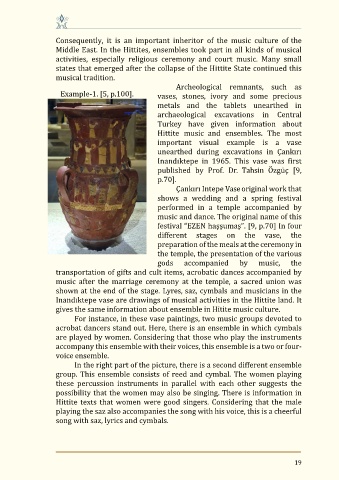
                   Example-1. [5, p.100].        vases,  stones,  ivory  and  some  precious
                                                 metals  and  the  tablets  unearthed  in
                                                 archaeological  excavations  in  Central
                                                 Turkey  have  given  information  about
                                                 Hittite  music  and  ensembles.  The  most
                                                 important  visual  example  is  a  vase
                                                 unearthed  during  excavations  in  Çankırı
                                                 Inandıktepe  in  1965.  This  vase  was  first
                                                 published  by  Prof.  Dr.  Tahsin  Özgüç  [9,
                                                 p.70].
                                                       Çankırı Intepe Vase original work that
                                                 shows  a  wedding  and  a  spring  festival
                                                 performed  in  a  temple  accompanied  by
                                                 music and dance. The original name of this
                                                 festival “EZEN haşşumaş”. [9, p.70] In four
                                                 different  stages  on  the  vase,  the
                                                 preparation of the meals at the ceremony in
                                                 the temple, the presentation of the various
                                                 gods    accompanied      by    music,    the
                  transportation of gifts and cult items, acrobatic dances accompanied by
                  music  after  the  marriage  ceremony  at  the  temple,  a  sacred  union  was
                  shown at the end of the stage. Lyres, saz, cymbals and musicians in the
                  Inandıktepe vase are drawings of musical activities in the Hittite land. It
                  gives the same information about ensemble in Hitite music culture.
                        For instance, in these vase paintings, two music groups devoted to
                  acrobat dancers stand out. Here, there is an ensemble in which cymbals
                  are played by women. Considering that those who play the instruments
                  accompany this ensemble with their voices, this ensemble is a two or four-
                  voice ensemble.
                        In the right part of the picture, there is a second different ensemble
                  group. This ensemble consists of reed and cymbal. The women playing
                  these  percussion  instruments  in  parallel  with  each  other  suggests  the
                  possibility that the women may also be singing. There is information in
                  Hittite texts that women were good singers. Considering that the male
                  playing the saz also accompanies the song with his voice, this is a cheerful
                  song with saz, lyrics and cymbals.


                                                                                           19

