


Page 22 - ANSAMBL IJROCHILIGI: TARIX, NAZARIYA, AMALIYOT: Хalqaro ilmiy-amaliy seminar materiallari to'plami
P. 22
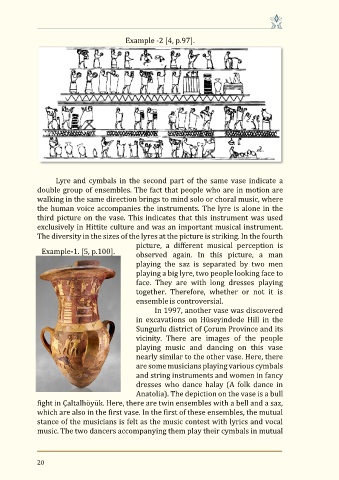
Example -2 [4, p.97].


                  Lyre and  cymbals  in  the  second  part  of  the  same  vase  indicate  a
            double group of ensembles. The fact that people who are in motion are
            walking in the same direction brings to mind solo or choral music, where
            the human voice accompanies the instruments. The lyre is alone in the
            third picture on the vase. This indicates that this instrument was used
            exclusively in Hittite culture and was an important musical instrument.
            The diversity in the sizes of the lyres at the picture is striking. In the fourth
                                          picture,  a  different  musical  perception  is
              Example-1. [5, p.100].      observed  again.  In  this  picture,  a  man
                                          playing  the  saz  is  separated  by  two  men
                                          playing a big lyre, two people looking face to
                                          face.  They  are  with  long  dresses  playing
                                          together.  Therefore,  whether  or  not  it  is
                                          ensemble is controversial.
                                                In 1997, another vase was discovered
                                          in  excavations  on  Hüseyindede  Hill  in  the
                                          Sungurlu district of Çorum Province and its
                                          vicinity.  There  are  images  of  the  people
                                          playing  music  and  dancing  on  this  vase
                                          nearly similar to the other vase. Here, there
                                          are some musicians playing various cymbals
                                          and string instruments and women in fancy
                                          dresses  who  dance  halay  (A  folk  dance  in
                                          Anatolia). The depiction on the vase is a bull
            fight in Çaltalhöyük. Here, there are twin ensembles with a bell and a saz,
            which are also in the first vase. In the first of these ensembles, the mutual
            stance of the musicians is felt as the music contest with lyrics and vocal
            music. The two dancers accompanying them play their cymbals in mutual


            20

