


Page 182 - Advanced Course
P. 182
KNX ADVANCED COURSE

                  the logarithmic impression of brightness by the human eye and is much better than a
                  linear output (equidistant values) of sensor 2. Still an option of limiting the amount of bus
                  telegrams per time unit should be available (not visible in this example here).

                  Regarding sensor 2 (Figure 18 lower image): If a measured value interval of 64 lux is still
                                                    nd
                  sufficient in the lower range (see 2  example above), then the factor should be 8 instead
                  of 4 as shown. During cyclical repetition of the measured value – if parameterised –values
                  like those shown above are completely unsuitable: assuming that 10 control curves are
                  implemented, up to 11 telegrams in total can occur every 650 msec. The bus load would
                  then already be over 30%. The aim should however be to remain below 2%. Assuming
                  that a maximum of 45 telegrams can be sent on the line on average, then 2% would
                  correspond to 0.9 telegrams / sec. In the case of the aforementioned 11 telegrams per
                  measured value, this means that a measured value may be sent approx. every 12
                  seconds. This timing resolution is probably quick enough, primarily, because the controller
                  calculates the new control values in proportion and does not always send constant
                  dimming steps as in integral-action closed-loop control. The correct parameter
                  combination for sending the cyclical measured values is then:

                  Base = 130 ms; Factor = 12 sec / 130 ms = 92

                    Dimming      Measured
                      value        value     250
                          250         0

                          250      500
                          200    1000

                          150    2000

                          125    3000
                           75    4500        25

                           25    8000
                                                      1000                               8000

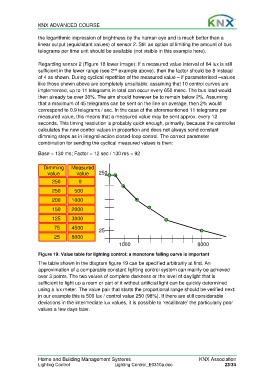
                  Figure 19: Value table for lighting control: a monotone falling curve is important
                  The table shown in the diagram figure 19 can be specified arbitrarily at first. An
                  approximation of a comparable constant lighting control system can mainly be achieved
                  over 3 points. The two values of complete darkness or the level of daylight that is
                  sufficient to light up a room or part of it without artificial light can be quickly determined
                  using a lux meter. The value pair that starts the proportional range should be verified next:
                  in our example this is 500 lux / control value 250 (98%). If there are still considerable
                  deviations in the intermediate lux values, it is possible to ‘recalibrate’ the particularly poor
                  values a few days later.


                  Home and Building Management Systems                                    KNX Association
                  Lighting Control                  Lighting Control_E0310a.doc                      23/34

