


Page 177 - Advanced Course
P. 177
KNX ADVANCED COURSE


                  5  Brightness Control


                  5.1  Areas of Application, Objective

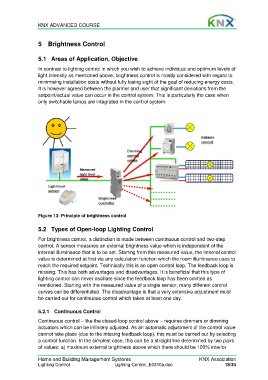
                  In contrast to lighting control in which you wish to achieve individual and optimum levels of
                  light intensity as mentioned above, brightness control is mostly considered with regard to
                  minimising installation costs without fully losing sight of the goal of reducing energy costs.
                  It is however agreed between the planner and user that significant deviations from the
                  setpoint/actual value can occur in the control system. This is particularly the case when
                  only switchable lamps are integrated in the control system.


                  Figure 13: Principle of brightness control

                  5.2  Types of Open-loop Lighting Control

                  For brightness control, a distinction is made between continuous control and two-step
                  control. A sensor measures an external brightness value which is independent of the
                  internal illuminance that is to be set. Starting from this measured value, the internal control
                  value is determined at first via any calculation function which the room illuminance uses to
                  reach the required setpoint. Technically this is an open control loop. The feedback loop is
                  missing. This has both advantages and disadvantages. It is beneficial that this type of
                  lighting control can never oscillate since the feedback loop has been omitted as
                  mentioned. Starting with the measured value of a single sensor, many different control
                  curves can be differentiated. The disadvantage is that a very extensive adjustment must
                  be carried out for continuous control which takes at least one day.

                  5.2.1  Continuous Control

                  Continuous control – like the closed-loop control above – requires dimmers or dimming
                  actuators which can be infinitely adjusted. As an automatic adjustment of the control value
                  cannot take place (due to the missing feedback loop), this must be carried out by selecting
                  a control function. In the simplest case, this can be a straight line determined by two pairs
                  of values: a) maximum external brightness above which there should be 100% interior

                  Home and Building Management Systems                                    KNX Association
                  Lighting Control                  Lighting Control_E0310a.doc                      18/34

