


Page 186 - Advanced Course
P. 186
KNX ADVANCED COURSE


                  6.5  Installation and Solution Notes

                  The most important factor in this option of open-loop/closed-loop lighting control is again
                  the optimum selection of the installation place and the alignment of the sensors. The
                  essential points have already been mentioned above but there is one additional factor: in
                  combined closed-loop/open-loop control systems, it must be at least ensured, that in the
                  situation of complete outdoor darkness all lights must be equally turned on to the same
                  value (which should be ruled by the specification of the lighting system).

                  A pure additive / subtractive offset control however means on the other hand, that the
                  difference between the master and the slave will always be equal or less than the given
                  value. The master dimming value can range between 0 and 100%, but the slave is limited
                  to less than this due to the offset. That means: If e.g. slave 1 = master + 20% (master at
                  the window side), and slave 2 = master + 40%, then both dependant rows can only be
                  controlled in the range 20 – 100 resp. 40 – 100 %. If the master has reached 0%, again
                  we have 2 options: the slaves shut off together with the master, then it is too dark there, or
                  they stay on, then it is too bright. But at least at full darkness all rows are at or above the
                  required lux value setpoint.

                  If you look at the same situation, but now with the master in row 3 (darkest area), with a
                  negative offset to the slaves, this means, at high outdoor light levels the dimming works
                  fine, but the closer you come to full darkness, the more unequal the distribution of light
                  would be. In the end row 1 reaches only 60%, row 2 goes to 80%. That this is not the
                  optimum, is self explanatory.

                  So the only conclusion can be: The sensor must be mounted in the window side row
                  which then also must be controlled via closed loop control!

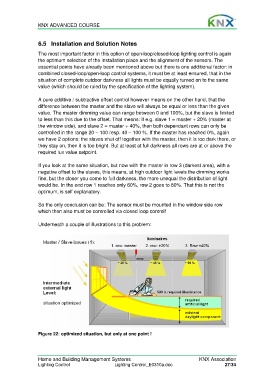
                  Underneath a couple of illustrations to this problem:


                  Figure 22: optimized situation, but only at one point !


                  Home and Building Management Systems                                    KNX Association
                  Lighting Control                  Lighting Control_E0310a.doc                      27/34

