


Page 185 - Advanced Course
P. 185
KNX ADVANCED COURSE


                  6.3  Available Devices

                  Since the offset adjustment is derived from the dimming value of a regulated dimming
                  actuator, it would be possible for example to use the active status response (8 bit) of this
                  type of dimming actuator and simply add it to the established offset in a function module
                  or visualisation program. The newly specified control value would then be sent to the next
                  controlled light strip via another group address.
                  This procedure is however only advisable if the function module or visualisation program
                  mentioned are also available or if there is a cost benefit in using them compared to a
                  multi-layered lighting control system.
                  In terms of device implementation, it is much simpler in any case to use multi-channel
                  dimming actuators with an integrated sensor connection and controller application. It is
                  also possible here to configure internal offset connections between the actuator channels
                  so that fewer bus telegrams can be sent. This solution not only saves device addresses
                  but also costs in general.

                  6.4  Parameterisation Example

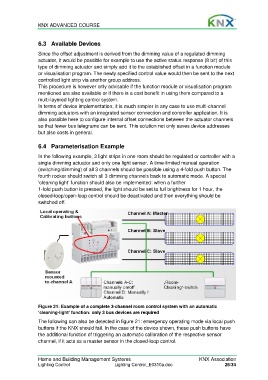
                  In the following example, 3 light strips in one room should be regulated or controller with a
                  single dimming actuator and only one light sensor. A time-limited manual operation
                  (switching/dimming) of all 3 channels should be possible using a 4-fold push button. The
                  fourth rocker should switch all 3 dimming channels back to automatic mode. A special
                  ‘cleaning light’ function should also be implemented: when a further
                  1-fold push button is pressed, the light should be set to full brightness for 1 hour, the
                  closed-loop/open-loop control should be deactivated and then everything should be
                  switched off.


                  Figure 21: Example of a complete 3-channel room control system with an automatic
                  ‘cleaning-light’ function: only 3 bus devices are required
                  The following can also be detected in figure 21: emergency operating mode via local push
                  buttons if the KNX should fail. In the case of the device shown, these push buttons have
                  the additional function of triggering an automatic calibration of the respective sensor
                  channel, if it acts as a master sensor in the closed-loop control.


                  Home and Building Management Systems                                    KNX Association
                  Lighting Control                  Lighting Control_E0310a.doc                      26/34

