


Page 188 - Advanced Course
P. 188
KNX ADVANCED COURSE

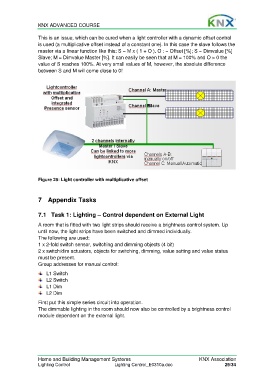
                  This is an issue, which can be cured when a light controller with a dynamic offset control
                  is used (a multiplicative offset instead of a constant one). In this case the slave follows the
                  master via a linear function like this: S = M x ( 1 + O ). O : = Offset [%]; S = Dimvalue [%]
                  Slave; M = Dimvalue Master [%]. It can easily be seen that at M = 100% and O > 0 the
                  value of S reaches 100%. At very small values of M, however, the absolute difference
                  between S and M will come close to 0!


                  Figure 25: Light controller with multiplicative offset


                  7  Appendix Tasks


                  7.1  Task 1: Lighting – Control dependent on External Light

                  A room that is fitted with two light strips should receive a brightness control system. Up
                  until now, the light strips have been switched and dimmed individually.
                  The following are used:
                  1 x 2-fold switch sensor, switching and dimming objects (4 bit)
                  2 x switch/dim actuators, objects for switching, dimming, value setting and value status
                  must be present.
                  Group addresses for manual control:

                      L1 Switch
                      L2 Switch
                      L1 Dim
                      L2 Dim

                  First put this simple series circuit into operation.
                  The dimmable lighting in the room should now also be controlled by a brightness control
                  module dependent on the external light.


                  Home and Building Management Systems                                    KNX Association
                  Lighting Control                  Lighting Control_E0310a.doc                      29/34

