


Page 1295 - YG 2019
P. 1295
TECHNICAL                TECHNICAL
 DATA  SUPER CUTTING END MILLS  DATA                SUPER CUTTING END MILLS


 1  Names of End Mill Parts  3  Speeds


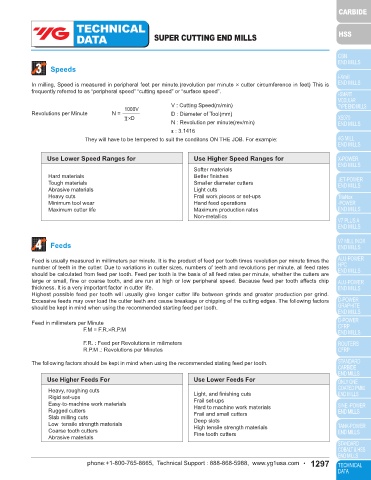
           In milling, Speed is measured in peripheral feet per minute.(revolution per minute × cutter circumference in feet) This is
           frequently referred to as “peripheral speed” “cutting speed” or “surface speed”.

                                          1000V          V : Cutting Speed(m/min)
           Revolutions per Minute                N =     D : Diameter of Tool(mm)

                                          π×D            N : Revolution per minute(rev/min)
                                                         π : 3.1416
                             They will have to be tempered to suit the conditons ON THE JOB. For example:


                 Use Lower Speed Ranges for                      Use Higher Speed Ranges for
                                                                 Softer materials
                 Hard materials                                  Better finishes
                 Tough materials                                 Smaller diameter cutters
                 Abrasive materials                              Light cuts
                 Heavy cuts                                      Frail work pieces or set-ups
                 Minimum tool wear                               Hand feed operations
                 Maximum cutter life                             Maximum production rates
                                                                 Non-metallics


             4    Feeds


           Feed is usually measured in millimeters per minute. It is the product of feed per tooth times revolution per minute times the
 2  Type of End Mill  number of teeth in the cutter. Due to variations in cutter sizes, numbers of teeth and revolutions per minute, all feed rates
           should be calculated from feed per tooth. Feed per tooth is the basis of all feed rates per minute, whether the cutters are
           large or small, fine or coarse tooth, and are run at high or low peripheral speed. Because feed per tooth affects chip
           thickness. It is a very important factor in cutter life.
           Highest possible feed per tooth will usually give longer cutter life between grinds and greater production per grind.
           Excessive feeds may over load the cutter teeth and cause breakage or chipping of the cutting edges. The following factors
           should be kept in mind when using the recommended starting feed per tooth.


           Feed in milimeters per Minute
                            F.M = F.R.×R.P.M

                            F.R. : Feed per Revolutions in milimeters
                            R.P.M .: Revolutions per Minutes

           The following factors should be kept in mind when using the recommended stating feed per tooth.

 Speed, feed and depth of cut are the most important factors to   Use Higher Feeds For  Use Lower Feeds For
 consider for best results in milling. Improper feeds and speeds often   REVOLUTION
 cause low production, poor work quality and unnecessary damage   Heavy, roughing cuts  Light, and finishing cuts
 to the cutter.  Rigid set-ups                                   Frail set-ups
 This section covers the basic principles of speed and feed selection   Easy-to-machine work materials  Hard to machine work materials
 for milling cutters and end mills. It will serve as a guide in setting-up   Rugged cutters  Frail and small cutters
 new milling jobs.  Slab milling cuts                            Deep slots
                 Low  tensile strength materials
 DEPTH OF CUT  FEED  Coarse tooth cutters                        High tensile strength materials
                 Abrasive materials                              Fine tooth cutters
 INTERRELATIONSHIP OF THREE FACTORS

 1296  • phone:+1-800-765-8665,  Technical Support : 888-868-5988,  www.yg1usa.com  phone:+1-800-765-8665,  Technical Support : 888-868-5988,  www.yg1usa.com  •  1297

