


Page 1297 - YG 2019
P. 1297
TECHNICAL                TECHNICAL
 DATA  SUPER CUTTING END MILLS  DATA                SUPER CUTTING END MILLS


 SPEED AND FEED CALCULATIONS  7  Resharpening Peripheral Cutting Edge
 FOR MILLING CUTTERS AND OTHER ROTATING TOOLS

 TO FIND  HAVING  FORMULA  1  RESHARPENING PERIPHERAL CUTTING EDGE

 Surface(or Periphery)  Diameter of Tool in milimeters    =D
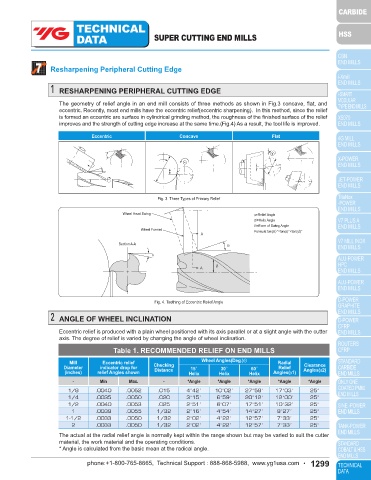
    Speed in meter  Revolutions per Minute    =R.P.M.  V=  D×3.1416×R.P.M.  The geometry of relief angle in an end mill consists of three methods as shown in Fig.3 concave, flat, and
                    eccentric. Recently, most end mills have the eccentric relief(eccentric sharpening).  In this method, since the relief
    Per Minute=S.P.M.  1000  is formed an eccentric are surface in cylindrical grinding method, the roughness of the finished surface of the relief
                    improves and the strength of cutting edge increase at the same time.(Fig.4) As a result, the tool life is improved.
 Revolutions  Surface Speed in meter per Minute   =S.P.M  R.P.M.=  V×1000
    Per Minute=R.P.M.  Diameter of Tool in milimeters   =D  D×3.1416  Eccentric  Concave  Flat


 Feed per Revolution  Feed in milimeters per Minute   =F.M.  F.R.=  F.M.
    in milimeters-F.R.  Revolution per Minute   =R.P.M.  R.P.M.

 Feed in milimeters  Feed per Revolution in milimeters   =F.R.
    Per Minute-F.M.  Revolution per Minute   =R.P.M.  F.M.= F.R.×R.P.M.
                                                     Fig. 3. Three Types of Primary Relief
 Number of Cutting Teeth  Number of Teeth in Tool    =T
    per Minute=T.M.  Revolution per Minute   =R.P.M.  T.M=T×R.P.M.  Wheel Head Swing  α=Relief Angle
                                                                                     Ø=Helix Angle
                                                                                     Θ=Form of Swing Angle
 Number of Teeth in Tool    =T  F.R.           Wheel Formed        A                 Formula:tan(Θ)°=tan(α)°×tan(Ø)°
 Feed per tooth=F.T.  F.T.=
 Feed per Revolution in milimeters   =R.P.M.  T
                                        Section A-A
                                                                            Θ
 Number of Teeth in Tool   =T                      α
 F.M.
 Feed per Tooth=F.T.  Feed in milimeters per Minute   =F.M.  F.T.=  T×R.P.M.  Ø
 Speed in Revolution per Minute   =R.P.M.                          A

 5  Case of Resharpening

                                                    Fig. 4. Toothing of Eccentric Relief Angle
 When the product finish become worse, the cutting edge must get dulled, chips become smaller and the cutting sound gets
 louder. In such cases, an end mill must be resharpened. The following are the damages of end mills when the resharpening   2
 is required.       ANGLE OF WHEEL INCLINATION
                    Eccentric relief is produced with a plain wheel positioned with its axis parallel or at a slight angle with the cutter
                    axis. The degree of relief is varied by changing the angle of wheel inclination.
                                      Table 1. RECOMMENDED RELIEF ON END MILLS

                        Mill       Eccentric relief   Checking     Wheel Angles(Deg.)Θ      Radial   Clearance
 (a) Wear on Primary Relief  (b) Wear on Cutting Face  (c) Chipping  Fig. 1. Damages of Cutting Edge  Diameter  indicator drop for   Distance  15°   30°   60°   Relief   Angles(α2)
                      (inches)   relief Angles shown           Helix     Helix     Helix   Angles(α1)
                         -        Min      Max.        -       *Angle    *Angle   *Angle    *Angle    *Angle
 6  Sharpen at Predetermined Wear Land  1/8  .0040  .0052  .015  4°42′  10°02′    27°58′   17°03′      25°
                                                     .020
                                          .0050
                                .0035
                       1/4
                                                              3°15′
                                                                                  20°12′
                                                                                                       25°
                                                                        6°59′
                                                                                           12°00′
                       1/2      .0040     .0053      .025     2°51′     6°07′     17°51′   10°32′      25°
 Cutters should be sharpened as soon as the wear land(Fig. 2.) reaches a predetermined
 width. This width should permit sharpening without excessive loss of tool life.  It may   1  .0038  .0055  1/32  2°16′  4°54′  14°27′  8°27′  25°
 vary from a few hundreths to some tenth of a millimeter, depending on the type of cutter   1-1/2  .0033  .0050  1/32  2°02′  4°22′  12°57′  7°33′  25°
 and the finish required  on the product. This method is used on production runs where   2  .0033  .0050  1/32  2°02′  4°22′  12°57′  7°33′  25°
 uneven amounts of stock is removed or where the material varies in machinability. It is   The actual at the radial relief angle is normally kept within the range shown but may be varied to suit the cutter
 also used on small quantity  product lots.  material, the work material and the operating conditions.
                    * Angle is calculated from the basic mean at the radical angle.
 Fig. 2. Wear Land
 1298  • phone:+1-800-765-8665,  Technical Support : 888-868-5988,  www.yg1usa.com  phone:+1-800-765-8665,  Technical Support : 888-868-5988,  www.yg1usa.com  •  1299

