


Page 394 - CarrLaneCatalog_2019ed-c.pdf
P. 394
LOCATING AND CLAMPING PRINCIPLES


                   CONTINUED FROM PREVIOUS PAGE


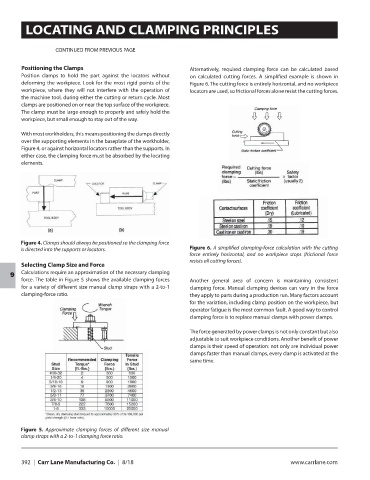
        Positioning the Clamps                                  Alternatively, required clamping force can be calculated based
        Position clamps to hold the part against the locators without   on calculated cutting forces. A simplified example is shown in
        deforming the workpiece. Look for the most rigid points of the   Figure 6. The cutting force is entirely horizontal, and no workpiece
        workpiece, where they will not interfere with the operation of   locators are used, so frictional forces alone resist the cutting forces.
        the machine tool, during either the cutting or return cycle. Most
        clamps are positioned on or near the top surface of the workpiece.
        The clamp must be large enough to properly and safely hold the
        workpiece, but small enough to stay out of the way.

        With most workholders, this means positioning the clamps directly
        over the supporting elements in the baseplate of the workholder,
        Figure 4, or against horizontal locators rather than the supports. In
        either case, the clamping force must be absorbed by the locating
        elements.


        Figure 4. Clamps should always be positioned so the clamping force
        is directed into the supports or locators.              Figure 6. A simplified clamping-force calculation with the cutting
                                                                force entirely horizontal, and no workpiece stops (frictional force
                                                                resists all cutting forces).
        Selecting Clamp Size and Force
        Calculations require an approximation of the necessary clamping
    9
        force. The table in Figure 5 shows the available clamping forces   Another general area of concern is maintaining consistent
        for a variety of different size manual clamp straps with a 2-to-1   clamping force. Manual clamping devices can vary in the force
        clamping-force ratio.                                   they apply to parts during a production run. Many factors account
                                                                for the variation, including clamp position on the workpiece, but
                                                                operator fatigue is the most common fault. A good way to control
                                                                clamping force is to replace manual clamps with power clamps.

                                                                The force generated by power clamps is not only constant but also
                                                                adjustable to suit workpiece conditions. Another benefit of power
                                                                clamps is their speed of operation: not only are individual power
                                                                clamps faster than manual clamps, every clamp is activated at the
                                                                same time.


        Figure 5. Approximate clamping forces of different size manual
        clamp straps with a 2-to-1 clamping force ratio.


        392  |  Carr Lane Manufacturing Co.  |  8/18                                             www.carrlane.com

