


Page 223 - Tafsir of surat at tawba repentance
P. 223
© Islamic Online University Usool at-Tafseer
words or expressions are referred to as mantooq, while those derived from their
implications are called mafhoom.
Mantooq (explicit) meanings may be derived in five different ways,
depending on the type of Arabic grammatical construction used.
1. Nass (explicit):
This method of deriving the mantooq meaning refers to any expression which
clearly indicates an idea, leaving no room for other interpretations; for example,
the following verse orders those who intend hajj tamattu‘, but are unable to
slaughter an animal:
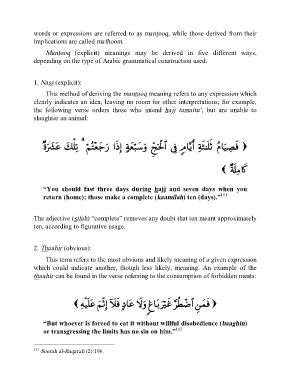
×ou|³tã y7ù=Ï? 3 öNçF÷èy_u #sÎ) >pyèö7yur Ædkptø:$# Îû 5Q$r& ÏpsW»n=rO ãP$uÅÁsù )
( ×'s#ÏB%x.
“You should fast three days during hajj and seven days when you
return (home); those make a complete (kaamilah) ten (days).” 111
The adjective (sifah) “complete” removes any doubt that ten meant approximately
ten, according to figurative usage.
2. Thaahir (obvious):
This term refers to the most obvious and likely meaning of a given expression
which could indicate another, though less likely, meaning. An example of the
thaahir can be found in the verse referring to the consumption of forbidden meats:
( Ïmøn=tã zNøOÎ) Ixsù 7$tã wur 8ø$t/ uöxî §äÜôÊ$# Ç`yJsù )
“But whoever is forced to eat it without willful disobedience (baaghin)
or transgressing the limits has no sin on him.” 112
111
Soorah al-Baqarah (2):196.
http://www.islamiconlineuniversity.com 46

