


Page 222 - Tafsir of surat at tawba repentance
P. 222
© Islamic Online University Usool at-Tafseer
7pt7s%u ãÌóstGsù (#qä9$s% $yJÏ9 tbrßqãèt §NèO öNÍkɲ!$|¡ÎpS `ÏB tbrãÎg»sàã tûïÏ%©!$#ur )
( $¢!$yJtFt br& È@ö6s% `ÏiB
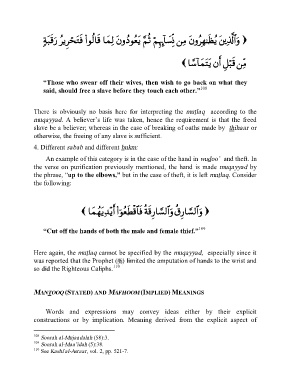
“Those who swear off their wives, then wish to go back on what they
said, should free a slave before they touch each other.” 108
There is obviously no basis here for interpreting the mutlaq according to the
muqayyad. A believer’s life was taken, hence the requirement is that the freed
slave be a believer; whereas in the case of breaking of oaths made by thihaar or
otherwise, the freeing of any slave is sufficient.
4. Different sabab and different hukm:
An example of this category is in the case of the hand in wudoo’ and theft. In
the verse on purification previously mentioned, the hand is made muqayyad by
the phrase, “up to the elbows,” but in the case of theft, it is left mutlaq. Consider
the following:
( $yJßgtÏ÷r& (#þqãèsÜø%$$sù èps%Í$¡¡9$#ur ä-Í$¡¡9$#ur )
“Cut off the hands of both the male and female thief.” 109
Here again, the mutlaq cannot be specified by the muqayyad, especially since it
was reported that the Prophet (r) limited the amputation of hands to the wrist and
so did the Righteous Caliphs. 110
MANTOOQ (STATED) AND MAFHOOM (IMPLIED) MEANINGS
Words and expressions may convey ideas either by their explicit
constructions or by implication. Meaning derived from the explicit aspect of
108
Soorah al-Mujaadalah (58):3.
109
Soorah al-Maa’idah (5):38.
110
See Kashf al-Asraar, vol. 2, pp. 521-7.
http://www.islamiconlineuniversity.com 45

