


Page 66 - test2
P. 66
IV.        Possible Flow Paths


                          The Panel identified three possible paths by which hydrocarbons could
                   have flowed up the well to the rig during the initial stage of the blowout: (1) up
                   the production casing annulus cement barrier and upward through the annulus
                   and the wellhead seal assembly;  (2) up the production casing and related
                                                     151
                   components from above the top wiper plug located on the float collar at 18,115
                   feet; or (3) up the last 189 feet of the production casing (the “shoe track”).

                   Scenario 1: Production Casing Annulus Cement Barrier and the Wellhead Seal
                   Assembly

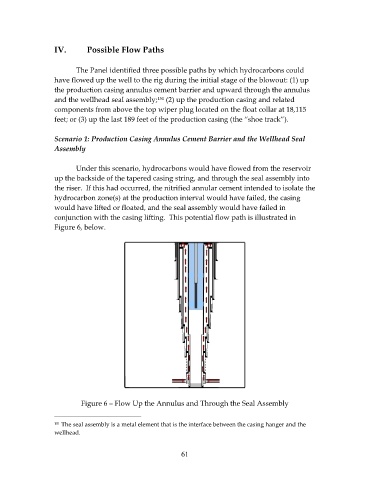
                          Under this scenario, hydrocarbons would have flowed from the reservoir
                   up the backside of the tapered casing string, and through the seal assembly into
                   the riser.  If this had occurred, the nitrified annular cement intended to isolate the
                   hydrocarbon zone(s) at the production interval would have failed, the casing
                   would have lifted or floated, and the seal assembly would have failed in
                   conjunction with the casing lifting.  This potential flow path is illustrated in
                   Figure 6, below.


                            Figure 6 – Flow Up the Annulus and Through the Seal Assembly

                   151  The seal assembly is a metal element that is the interface between the casing hanger and the
                   wellhead.


                                                             61

