


Page 48 - D&D - Player's Handbook
P. 48
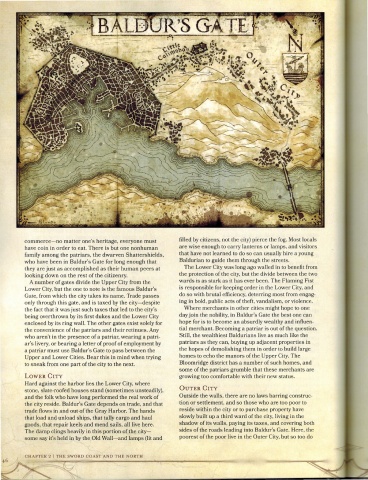
commerce- no matter one's heritage, everyone must   filled by citizens, not the city) pierce the fog.  Most locals
         have coin in order to eat. There is but one nonhuman   are wise enough to carry lanterns or lamps, and visitors
         family among the patriars, the dwarven Shattershields,   that have not learned to do so can usually hire a young
         who have been in Baldur's Gate for long enough that   Baldurian to guide them through the streets.
         they are just as accomplished as their human peers at   The Lower City was long ago walled in to benefit from
         looking down on the rest of the citizenry.        the protection of the city, but the divide between the two
           A number of gates divide the Upper City from the   wards is as stark as it has ever been. The Flaming Fist
         Lower City, but the one to note is the famous Baldur's   is responsible for keeping order in the Lower City, and
         Gate, from which the city takes its name. Trade passes   do so with brutal efficiency, deterring most from engag-
         only through this gate, and is taxed by the city-despite   ing in bold, public acts of theft, vandalism, or violence.
         the fact that it was just such taxes that led to the city's   Where merchants in other cities might hope to one
         being overthrown by its first dukes and the Lower City   day join the nobility, in Baldur's Gate the best one can
         enclosed by its ring wall. The other gates exist solely for   hope for is to become an absurdly wealthy and influen-
         the convenience of the patriars and their retinues. Any   tial merchant. Becoming a patriar is out of the question.
         who aren't in the presence of a patriar, wearing a patri-  Still, the wealthiest Baldurians live as much like the
         ar's livery, or bearing a letter of proof of employment by   patriars as they can, buying up adjacent properties in
         a patriar must use Baldur's Gate to pass between the   the hopes of demolishing them in order to build large
         Upper and Lower Cities. Bear this in mind when trying   homes to echo the manors of the Upper City. The
         to sneak from one part of the city to the next.   Bloomridge district has a number of such homes, and
                                                           some of the patriars grumble that these merchants are
         LOWER CITY                                        growing too comfortable with their new status.
         Hard against the harbor lies the Lower City, where
         stone, slate-roofed houses stand (sometimes unsteadily),   OUTER CITY
         and the folk who have long performed the real work of   Outside the walls, there are no laws barring construc-
         the city reside. Baldur's Gate depends on trade, and that   tion or settlement, and so those who are too poor to
         trade flows in and out of the Gray Harbor. The hands   reside within the city or to purchase property have
         that load and unload ships, that tally cargo and haul   slowly built up a third ward of the city, living in the
         goods, that repair keels and mend sails, all live here.   shadow of its walls, paying its taxes, and covering both
         The damp clings heavily in this portion of the city-  sides of the roads leading into Baldur's Gate. Here, the
         some say it's held in by the Old Wall-and lamps (lit and   poorest of the poor live in the Outer City,  but so too do


         CHAPTER 2  I THE  SWORD  COAST AND THE  NORTH

