


Page 29 - GeoPRISMS_Newsletter_Spring2018_Neat
P. 29
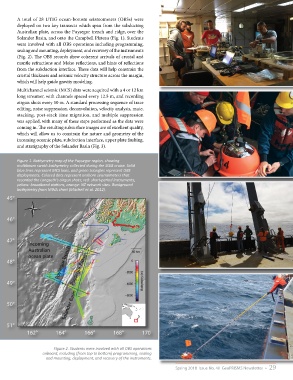
A total of 28 UTIG ocean-bottom seismometers (OBSs) were
        deployed on two key transects which span from the subducting
        Australian plate, across the Puysegur trench and ridge, over the
        Solander Basin, and onto the Campbell Plateau (Fig. 1). Students
        were involved with all OBS operations including programming,
        sealing and mounting, deployment, and recovery of the instruments
        (Fig. 2). The OBS records show coherent arrivals of crustal and
        mantle refractions and Moho reflections, and hints of reflections
        from the subduction interface. These data will help constrain the
        crustal thickness and seismic velocity structure across the margin,
        which will help guide gravity modeling.

        Multichannel seismic (MCS) data were acquired with a 4 or 12 km
        long streamer, with channels spaced every 12.5 m, and recording
        airgun shots every 50 m. A standard processing sequence of trace
        editing, noise suppression, deconvolution, velocity analysis, mute,
        stacking, post-stack time migration, and multiple suppression
        was applied, with many of these steps performed as the data were
        coming in. The resulting subsurface images are of excellent quality,
        which will allow us to constrain the nature and geometry of the
        incoming oceanic plate, subduction interface, upper plate faulting,
        and stratigraphy of the Solander Basin (Fig. 3).


        Figure 1. Bathymetry map of the Puysegur region, showing
        multibeam swath bathymetry collected during the SISIE cruise. Solid
        blue lines represent MCS lines, and green triangles represent OBS
        deployments. Colored dots represent onshore seismometers that
        recorded the Langseth’s airgun shots; red: short-period instruments,
        yellow: broadband stations, orange: NZ network sites. Background
        bathymetry from NIWA chart (Mitchell et al. 2012).


                       Figure 2. Students were involved with all OBS operations
                   onboard, including (from top to bottom) programming, sealing
                    and mounting, deployment, and recovery of the instruments.

                                                                          Spring 2018  Issue No. 40  GeoPRISMS Newsletter  •  29

