


Page 26 - GeoPRISMS_Newsletter_Spring2018_Neat
P. 26
Assessing changes in the state of a magma


        storage system over caldera-forming


        eruption cycles, a case study at Taupo


        Volcanic Zone, New Zealand


        Kari Cooper (UC Davis), Adam Kent (Oregon State University), Chad Deering
        (Michigan Tech), and collaborator Darren Gravley (University of Canterbury,

        New Zealand)


                                        he largest volcanic eruptions are rare events but when they occur can represent a global catastrophe.
                                        Relatively small eruptions may still have significant economic impacts (billions of dollars) and may
                                  Taffect the lives and livelihoods of large numbers of people – even in places quite distant from the
                                  erupting volcano (e.g., the relatively small Eyjafjallajokull eruption in Iceland in 2010). In an effort to study
                                  the processes that lead to large volcanic eruptions in more detail this project focuses on examining the
                                  highly active Taupo Volcanic Zone (TVZ) in New Zealand. Our goal is to develop a better understanding
                                  of how the temperature and mobility of a magma body below the surface changes before, during, and
                                  after a major eruption. As such the project contributes to an emerging understanding of the volcanoes
                                  and magmatic processes that can produce such large eruptions, and provides context for interpretation of
                                  hazard monitoring at these and other active volcanoes. The project also includes research experience for
                                  two K-12 teachers (one in the US and one in New Zealand), and will lead to development of new standard-
                                  based physics, chemistry and mathematics curricula.
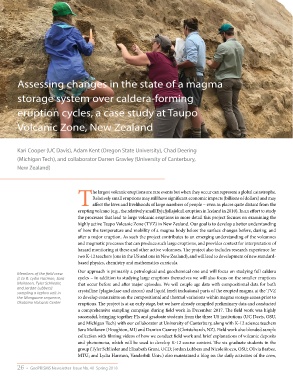
        Members of the field crew   Our approach is primarily a petrological and geochemical one and will focus on studying full caldera
        (L to R: Lydia Harmon, Sara   cycles – in addition to studying large eruptions themselves we will also focus on the smaller eruptions
        Moilanen, Tyler Schlieder,   that occur before and after major episodes. We will couple age data with compositional data for both
        and Jordan Lubbers)
        sampling a tephra unit in   crystalline (plagioclase and zircon) and liquid (melt inclusions) parts of the erupted magma at the TVZ
        the Mangaone sequence,    to develop constraints on the compositional and thermal variations within magma storage zones prior to
        Okataina Volcanic Center  eruptions. The project is at an early stage, but we have already compiled preliminary data and conducted
                                  a comprehensive sampling campaign during field work in December 2017. The field work was highly
                                  successful, bringing together PIs and graduate students from the three US institutions (UC Davis, OSU,
                                  and Michigan Tech) with our collaborator at University of Canterbury, along with K-12 science teachers
                                  Sara Moilanen (Houghton, MI) and Damien Canney (Christchurch, NZ). Field work also blended sample
                                  collection with filming videos of how we conduct field work and brief explanations of volcanic deposits
                                  and phenomena, which will be used to develop K-12 course content. The six graduate students in the
                                  group (Tyler Schlieder and Elizabeth Grant, UCD; Jordan Lubbers and Nicole Rocco, OSU; Olivia Barbee,
                                  MTU; and Lydia Harmon, Vanderbilt Univ.) also maintained a blog on the daily activities of the crew,

        26  •  GeoPRISMS Newsletter  Issue No. 40  Spring 2018

