


Page 27 - GeoPRISMS_Newsletter_Spring2018_Neat
P. 27
and participated in the educational videos. The field
        work also set the stage for monthly video conferences
        among the graduate students, which helps to maintain
        coordination between individual thesis projects and the
        project as a whole.
        Moving forward, we will collect a suite of data that will
        provide the foundation for a novel approach using two
        primary lines of investigation:
        1.   Constraints on the thermal history of pre-eruptive
        magma storage by coupling absolute ages for plagioclase
        crystal populations derived from U-series measurements
        with trace element diffusion models to constrain
        the maximum residence time of crystals at a given
        temperature; and

        2.   Quantification of the compositional heterogeneity
        of crystals and melt components, through in-situ
        measurements of trace-element and isotopic compositions in
        primary and accessory minerals and in melt inclusions (δ O in
                                                        18
        zircon, ε  in zircon; Pb isotopes in plagioclase and melt inclusions),
               Hf
        which will provide a measure of the degree
        to which the magma system is mixed across
        time and space within the reservoir as well
        as variations in the contributions of mantle
        and crustal sources to this reservoir.
        The unique strength of this approach is that
        it will allow simultaneous characterization
        of the thermal, compositional, and physical
        evolution of these silicic reservoirs.
        Therefore, the results of this study should
        be broadly relevant to other silicic volcanic
        systems and will represent an important
        step forward in improving our ability to
        interpret volcano monitoring data. Large
        silicic systems represent an end-member
        for volcanic activity globally, and more
        general models of the controls on the
        thermal conditions of magma storage
        beneath volcanoes will be developed by
        linking the results of this study with those
        from other ongoing projects. ■

        NSF GeoPRISMS Awards # 1654506,
        1654275, 1654128


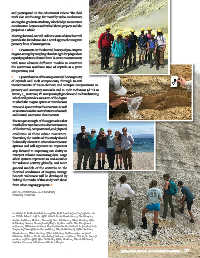
        From top to bottom: Members of the field team in front of a fumarole
        on White Island. Left to right: Adam Kent, Nicole Rocco, Kari Cooper,
        Jordan Lubbers, Damien Cranney, Sara Moilanen, Olivia Barbee, Tyler
        Schlieder; Darren Gravley sampling a tephra unit in the Mangaone
        sequence, Okataina Volcanic Center; Graduate students in front of Lake
        Taupo. Left to right, Jordan Lubbers, Elizabeth Grant, Lydia Harmon,
        Nicole Rocco, Olivia Barbee, Tyler Schlieder; Tephra sequence from
        Okataina Caldera Center (including Rotorua eruption, ~15 ka) in quarry
        section. Left to right, Tyler Schlieder, Lydia Harmon, Elizabeth Grant,
        Damien Cranney. Photos credit: Kari Cooper

                                                                          Spring 2018  Issue No. 40  GeoPRISMS Newsletter  •  27

