


Page 35 - MODULE QUALITY TOOLS DMQ 30262
P. 35
DMQ 30262
Issue
u
s
I
s
e
-
b
Sub-issue 1 S u b - i s s u e 2 Sub-issue 3 3 Sub-issue 4
e
u
S
s
e
1
u
Sub-issue 2
s
i
s
u
s
s
u
i
s
e
b
-
4
-
S
u
i
u
b
S
e
a
a
d
I Ideas s Ideas s I Ideas s Ideas s I Ideas s
d
d
a
I
d
e
d
a
e
I
e
a
e
y
d
a
i
a
m
g
r
t
.
.
3
F
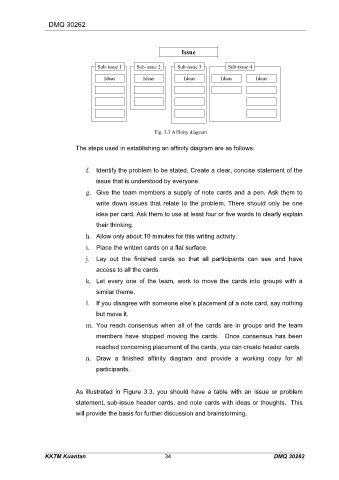
Fig. 3.3 Affinity diagram
g
i
i
f
i
n
3
f
A
The steps used in establishing an affinity diagram are as follows:
f. Identify the problem to be stated. Create a clear, concise statement of the
issue that is understood by everyone.
g. Give the team members a supply of note cards and a pen. Ask them to
write down issues that relate to the problem. There should only be one
idea per card. Ask them to use at least four or five words to clearly explain
their thinking.
h. Allow only about 10 minutes for this writing activity.
i. Place the written cards on a flat surface.
j. Lay out the finished cards so that all participants can see and have
access to all the cards.
k. Let every one of the team, work to move the cards into groups with a
similar theme.
l. If you disagree with someone else’s placement of a note card, say nothing
but move it.
m. You reach consensus when all of the cards are in groups and the team
members have stopped moving the cards. Once consensus has been
reached concerning placement of the cards, you can create header cards.
n. Draw a finished affinity diagram and provide a working copy for all
participants.
As illustrated in Figure 3.3, you should have a table with an issue or problem
statement, sub-issue header cards, and note cards with ideas or thoughts. This
will provide the basis for further discussion and brainstorming.
KKTM Kuantan 34 DMQ 30262

