


Page 98 - analysis-and-interpretation-of-astronomical-sp
P. 98
Analysis and Interpretation of Astronomical Spectra                                       98

22 Plasma Diagnostics for Emission Nebulae

22.1 Preliminary Remarks

In the “Spectroscopic Atlas for Amateur Astronomers” [33], a classification system is pre-
sented for the excitation classes of the ionised plasma in emission nebulae. Further this
process is practically demonstrated, based on several objects. Here, as a supplement, fur-
ther diagnostic possibilities are introduced, combined with the necessary physical back-
ground.

22.2 Overview of the Phenomenon “Emission Nebulae”

Reflection nebulae are interstellar gas and dust clouds which passively reflect the light of
the embedded stars. Emission nebulae however are shining actively. This process requires
that the atoms are first ionised by hot radiation sources with at least 25,000K. This re-
quires UV photons, above the so-called Lyman limit of 912 Å and corresponding to an ioni-
sation energy of >13.6 eV. This level is only achievable by very hot stars of the O- and early
B-Class generating this way a partially ionised plasma in the wider surroundings. By recom-
bination the ions recapture free electrons which subsequently cascade down to lower lev-
els, emitting photons of discrete frequencies , according to the energy difference

              . Thus, this nebulae produce by the fluorescence effect, similar to gas discharge
lamps, mainly "quasi monochromatic" light, i.e. a limited number of discrete emission lines,
which, with exception of the Supernova Remnants (SNR), are superimposed to a very weak
emission-continuum. The energetic requirements are mainly met by H II regions (e.g. M42),
Planetary Nebulae PN (e.g. M57) and SNR (e.g. M1). Further mentionable are the Nuclei of
Active Galaxies (AGN) and T-Tauri stars (sect. 17.2). The matter of the Nebulae consists
mainly of hydrogen, helium, nitrogen, oxygen, carbon, sulphur, neon and dust (silicate,
graphite etc.). Besides the chemical composition, the energy of the UV radiation, and the
temperature as well as density of the free electrons characterise the local state of the
plasma. This manifests itself directly in the intensity of emission lines, which simply allows
a first rough estimation of important plasma -parameters.

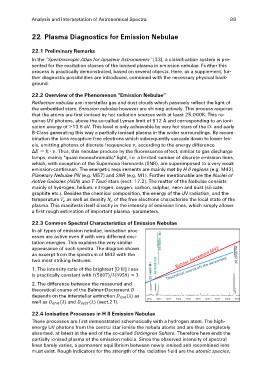
22.3 Common Spectral Characteristics of Emission Nebulae                    Olll 5006.84      Hα 6562.82
In all types of emission nebulae, ionisation proc-
esses are active even if with very different exci-
tation energies. This explains the very similar
appearance of such spectra. The diagram shows
an excerpt from the spectrum of M42 with the
two most striking features:
                                                              Olll 4958.91
1. The intensity ratio of the brightest [O III] lines  .  Hβ 4861.33
is practically constant with

2. The difference between the measured and
theoretical course of the Balmer-Decrement

depends on the interstellar extinction      as

well as  and                  (sect.21).

22.4 Ionisation Processes in H II Emission Nebulae

These processes are first demonstrated schematically with a hydrogen atom. The high-
energy UV photons from the central star ionise the nebula atoms and are thus completely
absorbed, at latest at the end of the so-called Strömgren Sphere. Therefore here ends the
partially ionised plasma of the emission nebula. Since the observed intensity of spectral
lines barely varies, a permanent equilibrium between newly ionised and recombined ions
must exist. Rough indicators for the strength of the radiation field are the atomic species,

