


Page 97 - analysis-and-interpretation-of-astronomical-sp
P. 97
Analysis and Interpretation of Astronomical Spectra                                          97
                                                                                    in [mag]
21.3 Balmer-Decrement and Color Excess

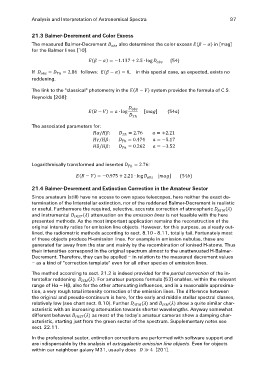
The measured Balmer-Decrement   also determines the color excess
for the Balmer lines [10].

If                    follows:                  , in this special case, as expected, exists no
reddening.

The link to the "classical" photometry in the           system provides the formula of C.S.
Reynolds [208]:

The associated parameters for:

Logarithmically transformed and inserted             :

21.4 Balmer-Decrement and Extinction Correction in the Amateur Sector

Since amateurs (still) have no access to own space telescopes, here neither the exact de-
termination of the Interstellar extinction, nor of the reddened Balmer-Decrement is realistic
or useful. Furthermore the required, selective, accurate correction of atmospheric

and instrumental      attenuation on the emission lines is not feasible with the here

presented methods. As the most important application remains the reconstruction of the
original intensity ratios for emission line objects. However, for this purpose, as already out-
lined, the radiometric methods according to sect. 8.10 - 8.11, totally fail. Fortunately most

of these objects produce H-emission lines. For example in emission nebulae, these are
generated far away from the star and mainly by the recombination of ionised H-atoms. Thus
their intensities correspond in the original spectrum almost to the unattenuated H-Balmer-
Decrement. Therefore, they can be applied – in relation to the measured decrement values
– as a kind of "correction template" even for all other species of emission lines.

The method according to sect. 21.2 is indeed provided for the partial correction of the in-

terstellar reddening  . For amateur purpose formula {53} enables, within the relevant

range of Hα – Hβ, also for the other attenuating influences, and in a reasonable approxima-
tion, a very rough total intensity correction of the emission lines. The difference between
the original and pseudo-continuum is here, for the early and middle stellar spectral classes,
relatively low (see chart sect. 8.10). Further       and show a quite similar char-

acteristic with an increasing attenuation towards shorter wavelengths. Anyway somewhat
different behaves     as most of the today’s amateur cameras show a damping char-

acteristic, starting just from the green sector of the spectrum. Supplementary notes see
sect. 22.11.

In the professional sector, extinction corrections are performed with software support and
are indispensable by the analysis of extragalactic emission line objects. Even for objects

within our neighbour galaxy M31, usually does           [201].

