


Page 27 - analysis-and-interpretation-of-astronomical-sp
P. 27
Analysis and Interpretation of Astronomical Spectra                                           27

8 Calibration, Normalisation and Radiometric Correction

8.1 The Calibration of the Wavelength

Usually spectra are plotted as course of the radiation intensity over the wavelength. In prin-
ciple, both dimensions can be calibrated. For most applications, only the calibration of the
wavelength is required. This can be done relatively easy with lines of known wavelength
within the spectrum, or absolutely with appropriate spectral calibration lamps. These pro-
cedures are well documented in literature eg [30], [411].

8.2 The Selective Attenuation of the Continuum Intensity

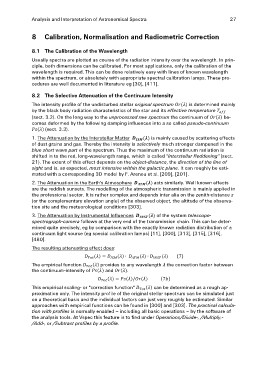
The intensity profile of the undisturbed stellar original spectrum     is determined mainly

by the black body radiation characteristics of the star and its effective temperature

(sect. 3.2). On the long way to the unprocessed raw spectrum the continuum of               be-

comes deformed by the following damping influences into a so called pseudo-continuum

(sect. 3.3).

1. The Attenuation by the Interstellar Matter        is mainly caused by scattering effects

of dust grains and gas. Thereby the intensity is selectively much stronger dampened in the
blue short wave part of the spectrum. Thus the maximum of the continuum radiation is

shifted in to the red, long-wavelength range, which is called "Interstellar Reddening" (sect.

21). The extent of this effect depends on the object-distance, the direction of the line of
sight and is, as expected, most intensive within the galactic plane. It can roughly be esti-

mated with a corresponding 3D model by F. Arenou et al. [209], [201].

2. The Attenuation in the Earth's Atmosphere         acts similarly. Well known effects

are the reddish sunsets. The modelling of the atmospheric transmission is mainly applied in
the professional sector. It is rather complex and depends inter alia on the zenith-distance

(or the complementary elevation angle) of the observed object, the altitude of the observa-
tion site and the meteorological conditions [303].

3. The Attenuation by Instrumental Influences        of the system telescope-

spectrograph-camera follows at the very end of the transmission chain. This can be deter-

mined quite precisely, eg by comparison with the exactly known radiation distribution of a
continuum light source (eg special calibration lamps) [11], [300], [313], [315], [316],
[480].

The resulting attenuating effect does:

The empirical function      provides to any wavelength the correction factor between
the continuum-intensity of    and .

This empirical scaling- or "correction function"     can be determined as a rough ap-

proximation only. The intensity profile of the original stellar spectrum can be simulated just
on a theoretical basis and the individual factors can just very roughly be estimated. Similar
approaches with empirical functions can be found in [300] and [303]. The practical calcula-
tion with profiles is normally enabled – including all basic operations – by the software of

the analysis tools. At Vspec this feature is to find under Operations/Divide-, /Multiply,-

/Add-, or /Subtract profiles by a profile.

