


Page 22 - analysis-and-interpretation-of-astronomical-sp
P. 22
Analysis and Interpretation of Astronomical Spectra                                   22

7.3 The Peak Intensity P                                            Ic          Ic I

The Line Intensity                                                          I
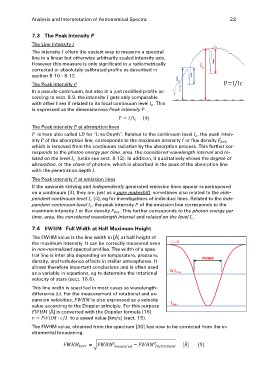
                                                                                           P=I/Ic
The intensity offers the easiest way to measure a spectral
line in a linear but otherwise arbitrarily scaled intensity axis..
However this measure is only significant in a radiometrically
corrected or absolutely calibrated profile as described in
section 8.10 - 8.12.

The Peak intensity
In a pseudo-continuum, but also in a just rectified profile ac-
cording to sect. 8.9, the intensity gets only comparable
with other lines if related to its local continuum level . This
is expressed as the dimensionless Peak intensity .

The Peak intensity at absorption lines

   is here also called for “Line Depth”. Related to the continuum level , the peak inten-
sity of the absorption line, corresponds to the maximum intensity or flux density ,
which is removed from the continuum radiation by the absorption process. This further cor-
responds to the photon energy per time, area, the considered wavelength interval and re-
lated on the level (units see sect. 8.12). In addition, it qualitatively shows the degree of
absorption, or the share of photons, which is absorbed in the peak of the absorption line
with the penetration depth .

The Peak intensity at emission lines

If the upwards striving and independently generated emission lines appear superimposed
on a continuum {3}, they are, just as a pure makeshift, sometimes also related to the inde-
pendent continuum-level {4}, eg for investigations of individual lines. Related to the inde-
pendent continuum-level , the peak intensity of the emission line corresponds to the
maximum intensity or flux density . This further corresponds to the photon energy per
time, area, the considered wavelength interval and related on the level .

7.4 Full Width at Half Maximum Height

The FWHM value is the line width in [Å] at half height of            I=0    FWHM
the maximum intensity. It can be correctly measured even            ½ Imax
in non-normalised spectral profiles. The width of a spec-
tral line is inter alia depending on temperature, pressure,
density, and turbulence effects in stellar atmospheres. It
allows therefore important conclusions and is often used
as a variable in equations, eg to determine the rotational
velocity of stars (sect. 16.6).

This line width is specified in most cases as wavelength-
difference . For the measurement of rotational and ex-

pansion velocities,  is also expressed as a velocity                Imax

value according to the Doppler principle. For this purpose
[Å] is converted with the Doppler formula {16}

to a speed value [km/s] (sect. 15).

The FWHM value, obtained from the spectrum [30] has now to be corrected from the in-
strumental broadening.

