


Page 121 - spectroscopic-atlas-5_0-english_Neat
P. 121
Spectroscopic Atlas for Amateur Astronomers                                            121
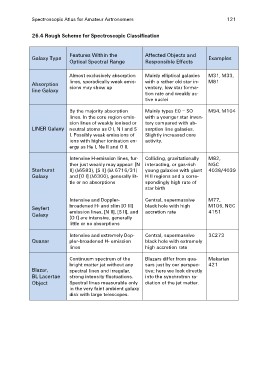
26.4 Rough Scheme for Spectroscopic Classification

Galaxy Type   Features Within the                  Affected Objects and         Examples
              Optical Spectral Range               Responsible Effects

Absorption    Almost exclusively absorption        Mainly elliptical galaxies   M31, M33,
line Galaxy   lines, sporadically weak emis-       with a rather old star in-   M81
              sions may show up                    ventory, low star forma-
                                                   tion rate and weakly ac-
                                                   tive nuclei

              By the majority absorption           Mainly types E0 – SO         M94, M104
              lines. In the core region emis-      with a younger star inven-
LINER Galaxy  sion lines of weakly ionised or      tory compared with ab-
              neutral atoms as O I, N I and S      sorption line galaxies.
              I. Possibly weak emissions of        Slightly increased core
              ions with higher ionisation en-      activity.
              ergy as He I, Ne II and O II.

Starburst     Intensive H-emission lines, fur-     Colliding, gravitationally   M82,
Galaxy        ther just weakly may appear: [N      interacting, or gas-rich     NGC
              II] (λ6583), [S II] (λλ 6716/31)     young galaxies with giant    4038/4039
              and [O I] (λ6300), generally lit-    H II regions and a corre-
              tle or no absorptions                spondingly high rate of
                                                   star birth

Seyfert       Intensive and Doppler-               Central, supermassive        M77,
Galaxy        broadened H- and slim [O III]        black hole with high         M106, NGC
              emission lines, [N II], [S II], and  accretion rate               4151
              [O I] are intensive, generally
              little or no absorptions

              Intensive and extremely Dop-         Central, supermassive        3C273
              pler-broadened H- emission
Quasar        lines                                black hole with extremely

                                                   high accretion rate

              Continuum spectrum of the            Blazars differ from qua-     Makarian
              bright matter jet without any        sars just by our perspec-    421
              spectral lines and irregular,        tive; here we look directly
Blazar,       strong intensity fluctuations.       into the synchrotron ra-
BL Lacertae   Spectral lines measurable only       diation of the jet matter.
Object        in the very faint ambient galaxy
              disk with large telescopes.

