


Page 123 - spectroscopic-atlas-5_0-english_Neat
P. 123
Spectroscopic Atlas for Amateur Astronomers 123
Table 71: LINER Galaxy M94
Heliocentric parameters according to NED [501] and [1]: Trujillo et al. [315].
Radial- Redshift ݖDistance Morphology Diameter Mass [1]
Velocity ݒ
+308km/s +0.0010 16.4 Mio ly SA 67‘000 ly 6.5 1010 M
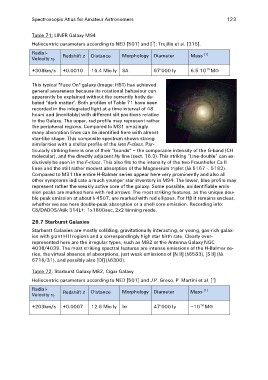
This typical "Face On" galaxy (Image: HST) has achieved
general awareness because its rotational behaviour can
apparently be explained without the currently hotly de-
bated "dark matter". Both profiles of Table 71 have been
recorded in the integrated light at a time interval of 48
hours and (inevitably) with different slit positions relative
to the Galaxy. The upper, red profile may represent rather
the peripheral regions. Compared to M31 amazingly
many absorption lines can be identified here with almost
star-like shape. This composite spectrum shows strong
similarities with a stellar profile of the late F-class. Par-
ticularly striking here is one of their "brands" – the comparable intensity of the G-band (CH
molecular), and the directly adjacent Hγ line (sect. 16.3). This striking “Line-double” can ex-
clusively be seen in the F-class. This also fits to the intensity of the two Fraunhofer Ca II
lines and the still rather modest absorption of the Magnesium triplet (λλ 5167 -. 5183).
Compared to M31 the entire H-Balmer series appear here very prominently and also all
other symptoms indicate a much younger star inventory in M94. The lower, blue profile may
represent rather the weakly active core of the galaxy. Some possible, unidentifiable emis-
sion peaks are marked here with red arrows. The most striking features, as the unique dou-
ble peak emission at about λ 4507, are marked with red ellipses. For Hβ it remains unclear,
whether we see here double-peak absorption or a shell core emission. Recording info:
C8/DADOS/Atik 314L+: 1x1800sec, 2x2 binning mode.
26.7 Starburst Galaxies
Starburst Galaxies are mostly colliding, gravitationally interacting, or young, gas-rich galax-
ies with giant H II regions and a correspondingly high star birth rate. Clearly over-
represented here are the irregular types, such as M82 or the Antenna Galaxy NGC
4038/4039. The most striking spectral features are intense emissions of the H-Balmer se-
ries, the virtual absence of absorptions, just weak emissions of [N II] (λ6583), [S II] (λλ
6716/31), and possibly also [OI] (λ6300).
Table 72: Starburst Galaxy M82, Cigar Galaxy
Heliocentric parameters according to NED [501] and J.P. Greco, P. Martini et al. [1]
Radial- Redshift ݖDistance Morphology Diameter Mass [1]
Velocity ݒ
+203km/s +0.0007 12.6 Mio ly Irr 47‘000 ly ~1010 M

