


Page 150 - spectroscopic-atlas-5_0-english_Neat
P. 150
Spectroscopic Atlas for Amateur Astronomers 150
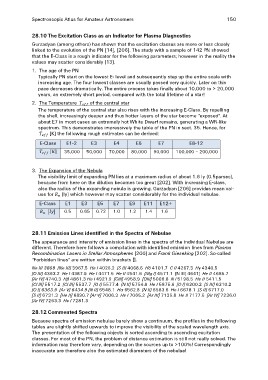
28.10 The Excitation Class as an Indicator for Plasma Diagnostics
Gurzadyan (among others) has shown that the excitation classes are more or less closely
linked to the evolution of the PN [14], [206]. The study with a sample of 142 PN showed
that the E-Class is a rough indicator for the following parameters; however in the reality the
values may scatter considerably [13].
1. The age of the PN
Typically PN start on the lowest E- level and subsequently step up the entire scale with
increasing age. The four lowest classes are usually passed very quickly. Later on this
pace decreases dramatically. The entire process takes finally about 10,000 to > 20,000
years, an extremely short period, compared with the total lifetime of a star!
2. The Temperature ܶ of the central star
The temperature of the central star also rises with the increasing E-Class. By repelling
the shell, increasingly deeper and thus hotter layers of the star become "exposed". At
about E7 in most cases an extremely hot White Dwarf remains, generating a WR-like
spectrum. This demonstrates impressively the table of the PN in sect. 35. Hence, for
ܶ [K] the following rough estimates can be derived:
E-Class E1-2 E3 E4 E5 E7 E8-12
ܶ [ ]ܭ35,000 50,000 70,000 80,000 90,000 100,000 – 200,000
3. The Expansion of the Nebula
The visibility limit of expanding PN lies at a maximum radius of about 1.6 ly (0.5parsec),
because from here on the dilution becomes too great [202]. With increasing E-class,
also the radius of the expanding nebula is growing. Gurzadyan [206] provides mean val-
ues for ܴ [ly] which however may scatter considerably for the individual nebulae.
E-Class E1 E3 E5 E7 E9 E11 E12+
ܴ [݈ ]ݕ0.5 0.65 0.72 1.0 1.2 1.4 1.6
28.11 Emission Lines identified in the Spectra of Nebulae
The appearance and intensity of emission lines in the spectra of the individual Nebulae are
different. Therefore here follows a compilation with identified emission lines from Plasma
Recombination Lasers in Stellar Atmospheres [200] and Frank Gieseking [202]. So-called
"Forbidden lines" are written within brackets [].
Ne III 3869 [Ne III] 3967.5 He I 4026.2 [S II] 4068.6 Hδ 4101.7 C II 4267.3 Hγ 4340.5
[O III] 4363.2 He I 4387.9 He I 4471.5 He II 4541.6 [Mg I] 4571.1 [N III] 4641] He II 4685.7
[Ar IV] 4740.3 Hβ 4861.3 He I 4921.9 [Olll] 4958.9 [Olll] 5006.8 N l 5198.5 He II 5411.5
[Cl lII] 5517.2 [Cl lII] 5537.7 [O I] 5577.4 [N II] 5754.8 He I 5875.6 [O I] 6300.2 [S III] 6310.2
[O I] 6363.9 [Ar V] 6434.9 [N II] 6548.1 Hα 6562.8 [N II] 6583.6 He I 6678.1 [S II] 6717.0
[S II] 6731.3 [He II] 6890.7 [Ar V] 7006.3 He I 7065.2 [Ar III] 7135.8 He II 7177.5 [Ar IV] 7236.0
[Ar IV] 7263.3 He l 7281.3
28.12 Commented Spectra
Because spectra of emission nebulae barely show a continuum, the profiles in the following
tables are slightly shifted upwards to improve the visibility of the scaled wavelength axis.
The presentation of the following objects is sorted according to ascending excitation
classes. For most of the PN, the problem of distance estimation is still not really solved. The
information may therefore vary, depending on the sources up to >100%! Correspondingly
inaccurate are therefore also the estimated diameters of the nebulae!

