


Page 23 - spectroscopic-atlas-5_0-english_Neat
P. 23
Spectroscopic Atlas for Amateur Astronomers                                    23

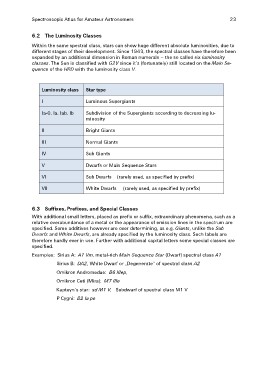
6.2 The Luminosity Classes

Within the same spectral class, stars can show huge different absolute luminosities, due to
different stages of their development. Since 1943, the spectral classes have therefore been
expanded by an additional dimension in Roman numerals – the so called six luminosity
classes. The Sun is classified with G2V since it’s (fortunately) still located on the Main Se-
quence of the HRD with the luminosity class V.

Luminosity class Star type

I Luminous Supergiants

Ia-0, Ia, Iab, Ib  Subdivision of the Supergiants according to decreasing lu-
                   minosity

II Bright Giants

III Normal Giants

IV Sub Giants

V Dwarfs or Main Sequence Stars

VI Sub Dwarfs (rarely used, as specified by prefix)

VII White Dwarfs (rarely used, as specified by prefix)

6.3 Suffixes, Prefixes, and Special Classes
With additional small letters, placed as prefix or suffix, extraordinary phenomena, such as a
relative overabundance of a metal or the appearance of emission lines in the spectrum are
specified. Some additives however are over determining, as e.g. Giants, unlike the Sub
Dwarfs and White Dwarfs, are already specified by the luminosity class. Such labels are
therefore hardly ever in use. Further with additional capital letters some special classes are
specified.

Examples: Sirius A: A1 Vm, metal-rich Main Sequence Star (Dwarf) spectral class A1

               Sirius B: DA2, White Dwarf or „Degenerate“ of spectral class A2

               Omikron Andromedae: B6 IIIep,

               Omikron Ceti (Mira): M7 IIIe

               Kapteyn‘s star: sd M1 V, Subdwarf of spectral class M1 V

               P Cygni: B2 Ia pe

