


Page 26 - spectroscopic-atlas-5_0-english_Neat
P. 26
Spectroscopic Atlas for Amateur Astronomers                                                  26

8 Spectral Class O

8.1 Overview

The O-Class comprises the hottest, most mas-                  Name            Spec. Class    Vm
sive and shortest-living stars of the universe. At HD
                                                                              O7.5 III e     4.1
the end of their short lives, they will all end, due  24912   Menkhib, ξ Per  O9.5 Ia e      4.3
to their huge masses, in a SN explosion. Subse-       30614   α Cam           O9.5 II+B0III  2.4
                                                      36486   Mintaka, δ Ori  O8 III         3.4
quently the only remains will consist of a very       36861   Meissa, λ Ori   O6 pe v        5.1
small, extremely compact Neutron Star or even                                 O9 III         2.8
a Black Hole. These blue shining, extreme types                               O9.5 V         3.8
                                                                              O9.5 Ib        1.8
of stars are very rare. For the Milky Way only        37022 Θ1 Ori C          O7 Ve          4.6
                                                                              O7             5.0
about 20,000 representatives of the O-type are 37043 Nair al Saif, ι Ori      O9 Ib          4.4
                                                                              O4 I f(n) p    2.3
estimated. As a result of their tremendous lumi-      37468   σ Ori,          O9.5 V n       2.6
                                                      37742   Alnitak, ζ Ori  O7 III n(f)    5.0
nosity two bright representatives of this class       47839   15 Mon
                                                      57060   29 CMa
are visible in a distance of some 1,000 ly in the
constellation Orion: Alnitak (ζ Ori) 1.8m and Min-
taka 2.2m (δ Ori). All these stars are late O-

Types. Bright representatives of earlier O-types 57061 30 CMa

are only found in the southern sky, such as           66811   Naos, ζ Pup
Naos, 2.3m (ζ Puppis). The list on the right          149757  ζ Oph
                                                      203064  68 Cyg
shows O- stars with an apparent magnitude V
from about 5m upwards, which are spectro-

scopically accessible even for averagely equipped amateurs.

Two other Orion stars ε- (Alnilam), and κ- (Saiph), are classified as B0, just scarcely missing
the O-Class. Significantly fainter, but also much further distant, is the multiple Trapezium
star θ1 Ori. Its C-component θ1 Ori C is a spectral type O6pe V and plays a key role for the

ionisation of central parts in the Orion nebula M42.

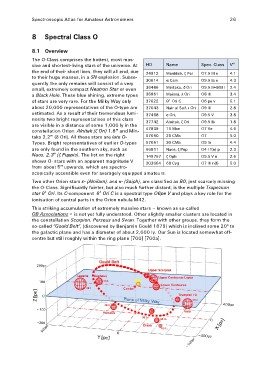
This striking accumulation of extremely massive stars – known as so-called
OB Associations – is not yet fully understood. Other slightly smaller clusters are located in
the constellation Scorpion, Perseus and Swan. Together with other groups, they form the
so-called "Gould Belt", (discovered by Benjamin Gould 1879) which is inclined some 20° to
the galactic plane and has a diameter of about 2,000 ly. Our Sun is located somewhat off-
centre but still roughly within the ring plane [700] [700a].

