


Page 27 - spectroscopic-atlas-5_0-english_Neat
P. 27
Spectroscopic Atlas for Amateur Astronomers                 27

8.2 Parameters of the Early to Late O-Class Stars

The following table shows the data exclusively for the Main Sequence Stars of the O-class
compared to the Sun ( ) and according to [701] and other sources. Especially for the lower
temperature limit, and even between reputable sources, are to find here clear differences in
the published values (see also [30]).

Mass  Stay on Main  Temperature pho- Radius Luminosity L/L
M/M   Sequence [y]
                    tosphere [K]             R/R

60 – 20 1M – 10M    50,000 –25,000 15 – 9 800,000 – 90,000

The O-class is open-ended. Currently, the top ranking is O3 with a surface temperature of
about 50,000 K [1]. The late O9 class has been subdivided into decimal subclasses.

8.3 Spectral Characteristics of the O-Class

Spectra of the O-class are dominated by relatively low intense absorptions of singly or mul-
tiply ionised elements. The extremely high temperatures cause in addition to neutral helium
He I, also lines of ionised helium (He II). In the early O-classes He II may also appear as
emission line. In earlier times the appearance of He II in the spectrum was used as the main
criterion for the definition of the O-class [2]. Today, in higher-resolved spectra, it can be de-
tected already in the B0 class. Further appear also multiply ionised metals, as C III, N III, [O
III] and Si IV. Due to the extreme temperatures, the degree of ionisation is here too high for
the H-Balmer Series and their line intensity therefore only weak [30]. If H-lines appear in
emission, the suffix "e" is added to the class letter (Oe). If He and/or N are seen in emis-
sion, the suffix "f" is added. “Of” stars seem to form the link between the O-Class and the
Wolf-Rayet Stars, probably also to the LBV stars (see sect. 9/11).

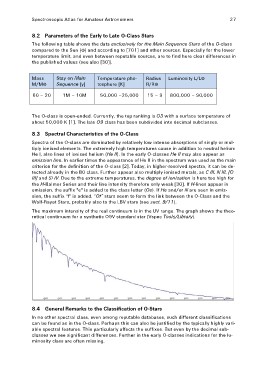
The maximum intensity of the real continuum is in the UV range. The graph shows the theo-
retical continuum for a synthetic O9V standard star (Vspec Tools/Library).

8.4 General Remarks to the Classification of O-Stars

In no other spectral class, even among reputable databases, such different classifications
can be found as in the O-class. Perhaps this can also be justified by the typically highly vari-
able spectral features. This particularly affects the suffixes. But even by the decimal sub-
classes we see significant differences. Further in the early O-classes indications for the lu-
minosity class are often missing.

