


Page 28 - spectroscopic-atlas-5_0-english_Neat
P. 28
Spectroscopic Atlas for Amateur Astronomers 28
8.5 Commented Spectra
Table 1: Alnitak (ζ Ori) and Mintaka (δ Ori)
This table shows two broadband spectra (200L grating) providing an
overview on the spectral features of the late O-class.
Alnitak (1200 ly) belongs to the spectral class O9.5 Ib, representing the
lower level of the so-called Supergiants. The Wikipedia picture shows the
size of the star compared to the Sun.
Mintaka (1200 ly) is classified slightly below with O9.5 II (Bright Giant). Both stars are
dominant components in multiple star systems and their surface temperature is about
25,000 K. In spite of the minimal class difference even in these low-resolution spectra,
some differences can be observed (see comment below).
Table 2: Detailed spectrum of Alnitak (ζ Ori)
This table shows for Alnitak (1200 ly), a late O-Type star, two higher re-
solved spectra in the blue- and red wavelength domains (900L grating).
Here, the main distinguishing feature between the two spectra of Table 1
is clearly visible. The Hα line at λ 6562 forms here a textbook example of
a P-Cygni profile with a red shifted emission- and a blue-shifted absorp-
tion line. This is always an indication for radially ejected matter by the
star, a common process for some members of this extreme stellar class.
The wavelength shift results here to about 7 Å. According to the Doppler
law this yields a gas-expansion velocity ݒ ≈ 320 ݇݉/ݏ.
∆ߣ
ݒ = ߣ ∙ ܿ
ߣ = Wavelength of the line, ܿ = 300ᇱ000 ݇݉/( ݏspeed of light)
For further information, refer to Table 13 for P Cygni or [30].
Line identification:
The line identification is based amongst others on [1], [5], [51], [56], [57]
Table 3: Θ1Ori C, HD37022 mV =+5.13m and 68 Cygni HD203064 mV =+5.04m
This table shows two apparently faint representatives of the early to mid-O-class, which are
easily accessible for the averagely equipped amateur (200L grating).
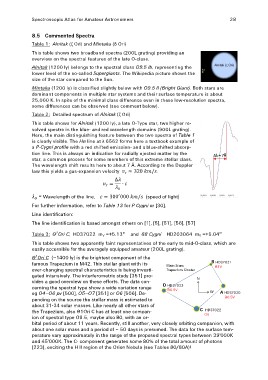
Θ1Ori C (~1400 ly) is the brightest component of the Main Stars B HD37021
famous Trapezium in M42. This stellar giant with its Trapezium Cluster
ever-changing spectral characteristics is being investi- B1V
gated intensively. The interferometric study [351] pro- D HD37023 N
vides a good overview on these efforts. The data con-
cerning the spectral type show a wide variation range B0.5V W A HD37020
eg O4–O6 pv [500], O5–O7 [351] or O6 [506]. De-
B0.5V
pending on the source the stellar mass is estimated to
about 31-34 solar masses. Like nearly all other stars of C HD37022
the Trapezium, also Θ1Ori C has at least one compan-
ion of spectral type O9.5, maybe also B0, with an or- O6
bital period of about 11 years. Recently, still another, very closely orbiting companion, with
about one solar mass and a period of ~ 50 days is presumed. The data for the surface tem-
perature vary approximately in the range of the proposed spectral types between 39'000K
and 45'000K. The C- component generates some 80% of the total amount of photons
[223], exciting the H II region of the Orion Nebula (see Tables 80/80A)!

