


Page 52 - DINOSOUR ATLAS
P. 52
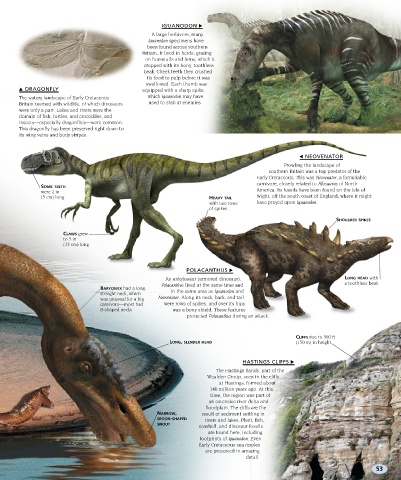
IGuANoDoN .
                                                       A large herbivore, many
                                                      Iguanodon specimens have
                                                     been found across southern
                                                    Britain. It lived in herds, grazing
                                                     on horsetails and ferns, which it
                                                    cropped with its bony, toothless
                                                    beak. Cheek teeth then crushed
                                                     its food to pulp before it was
                                                     swallowed. Each thumb was
        u DrAGoNfLY                                 equipped with a sharp spike,
        The watery landscape of Early Cretaceous      which Iguanodon may have
        Britain teemed with wildlife, of which dinosaurs   used to stab at enemies.
        were only a part. Lakes and rivers were the
        domain of fish, turtles, and crocodiles, and
        insects—especially dragonflies—were common.
        This dragonfly has been preserved right down to
        its wing veins and body stripes.


                                                                                                            , NEoVENATor
                                                                                                      Prowling the landscape of
                                                                                                 southern Britain was a top predator of the
                                                                                            Early Cretaceous. This was Neovenator, a formidable
                                                                                            carnivore, closely related to Allosaurus of North
                some teeth
                were 2 in                                                                   America. Its fossils have been found on the Isle of
                (5 cm) long                                                 heavy tail      Wight, off the south coast of England, where it might
                                                                            with two rows   have preyed upon Iguanodon.
                                                                            of spikes
                                                                                                                         shoulder spikes

                        Claws grew
                        to 5 in
                        (13 cm) long


                                                                   poLACANTHuS .
                                                            An ankylosaur (armored dinosaur),                               loNg head with
                                                           Polacanthus lived at the same time and                           a toothless beak
                                     BaryoNyx had a long,
                                     straight neck, which     in the same area as Iguanodon and
                                     was unusual for a big   Neovenator. Along its neck, back, and tail
                                     carnivore—most had    were rows of spikes, and over its hips
                                     S-shaped necks            was a bony shield. These features
                                                                    protected Polacanthus during an attack.


                                                                                                          Cliffs rise to 500 ft
                                                             loNg, sleNder head                           (150 m) in height


                                                                                       HASTINGS CLIffS .
                                                                              The Hastings Sands, part of the
                                                                           Wealden Group, seen in the cliffs
                                                                               at Hastings, formed about
                                                                            140 million years ago. At this
                                                                            time, the region was part of
                                                                           an extensive river delta and
                                                                          floodplain. The cliffs are the
                                                         Narrow,         result of sediment settling in
                                                         spooN-shaped     rivers and lakes. Plant, fish,
                                                         sNout
                                                                        seashell, and dinosaur fossils
                                                                           are found here, including
                                                                        footprints of Iguanodon. Even
                                                                        Early Cretaceous sea ripples
                                                                          are preserved in amazing
                                                                                         detail.
                                                                                                                                       53

