Page 50 - DINOSOUR ATLAS
P. 50

europe
         Portugal                                                                     , BracHiosaurus
    50
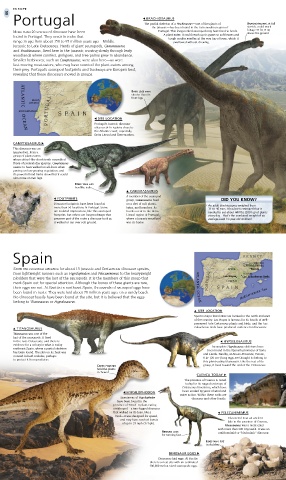
                                                                                       The partial skeleton of a Brachiosaurus—one of the giants of
                                                                                                                                                     stretch, could reach
                                                                                            the Jurassic—has been found in the Estremadura region of    Brachiosaurus, at full
         More than 20 SpecieS of dinosaur have been                                            Portugal. This long-necked sauropod may have lived in herds.   foliage 43 ft (13 m)
                                                                                                                                                     above the ground
         found in Portugal. They occur in rocks that                                               A plant-eater, it could reach up to graze on soft leaves and
                                                                                                      tough conifer needles at the very top of trees, which it
         range in age from about 150 to 95 million years ago—Middle                                     swallowed without chewing.
         Jurassic to Late Cretaceous. Herds of giant sauropods, Camarasaurus
         and Brachiosaurus, lived here in the Jurassic, moving slowly through leafy
         woodlands where conifers, ginkgoes, and tree palms grew in abundance.
         Smaller herbivores, such as Camptosaurus, were also here—as were
         fast-moving meat-eaters, who may have counted the plant-eaters among
         their prey. Portugal’s sauropod footprints and trackways are Europe’s best,
         revealing that these dinosaurs moved in groups.


                                                                               Back legs were
                                                                               shorter than its
                               ,                                               front legs
                    "%)2!      !
                  ,)4/2!,
                              '
                              5
            %342%-!$52!
                              4     3 0 ! ) .
                             2                           , site location
                             /
                             0                           Portugal’s Jurassic dinosaur
                                                         sites occur in regions close to
                                                         the Atlantic coast, especially
              !4,!.4)#    /#%!.
                                                         Beira Litoral and Estremadura.

         caMptosaurus .
         This dinosaur was an
         iguanodont, from a
         group of plant-eaters
         whose chisel-like cheek teeth resembled
         those of present-day iguanas. Camptosaurus
         seems to have walked on all-fours when
         grazing on low-growing vegetation, and
         its powerful hind limbs show that it could
         also move on two legs.
                                              Four toes with
                                              hooflike nails
                                                                            u caMarasaurus
                                                                            A member of the sauropod
                                 , footprints                               group, Camarasaurus lived                                did you know?
                                 Dinosaur footprints have been found at     on a diet of soft plants,                       . An adult Brachiosaurus weighed from
                                 more than 50 locations in Portugal. Some   twigs, and branches. Its                         31 to 46 tons. It has been estimated that it
                                 are isolated impressions, like this sauropod   fossils occur in the Beira                   needed to eat about 440 lbs (200 kg) of plants
                                 footprint, but others are long trackways that   Litoral region of Portugal,                 every day—that’s the combined weight of six
                                 preserve part of the route a dinosaur took as   where a Jurassic woodland                   average-sized 10-year-old children!
                                 it walked or ran over soft ground.         was its home.


         Spain                                                                                                                                    & 2 ! . # %


                                                                                                                                                        !.$/22!
                                                                                                                                                   ,,%)$!  ,%2)$!
         Spain haS produced evidence for about 15 Jurassic and Cretaceous dinosaur species,                                              3/2)!         "ASTÞS
         from lightweight runners such as Hypsilophodon and Pelecanimimus to the heavyweight                                                      4%25%,
         plodders that were the last of the sauropods. It is the members of this group that                                           ,AS (OYAS   ,AS :ABACHERAS "EDS
         mark Spain out for special attention. Although the bones of these giants are rare,                                  0 /2 45 ' ! ,  #5%.#!
         their eggs are not. At Bastús in northeast Spain, thousands of sauropod eggs have                             !4,!.4)# /#%!.  3 0 ! ) .
         been found in nests. They were laid about 70 million years ago, on a sandy beach.                                                      .FEJUFSSBOFBO 4FB
         No dinosaur fossils have been found at the site, but it is believed that the eggs
         belong to Titanosaurus or Hypselosaurus.


                                                                                                                     u site location
                                                                                                                     Spain’s major fossil sites are located in the north and east
                                                                                                                     of the country. Las Hoyas is famous for its fossils of well-
                                                                                                                     preserved Late Cretaceous plants and birds, and the Las
         u titanosaurus                                                                                              Zabacheras Beds have produced evidence for dinosaurs.
         Titanosaurus was one of the
         last of the sauropods. It lived
         in the Late Cretaceous, and there is                                                                                        , Hypselosaurus
         evidence for a colony in what is today                                                                                 Incomplete Hypselosaurus skeletons have
         northeast Spain, where a partial skeleton                                                                           been found in the Spanish provinces of Soria
         has been found. The skin on its back was                                                                         and Lleida. Nearby, at Aix-en-Provence, France,
         covered in hard nodules, perhaps                                                                                 8 in- (20 cm-) long eggs are thought to belong to
         to protect it from predators.
                                                                                                                          this plant-eating titanosaur. Like the rest of its
                                                           cheek pouches                                                  group, it lived toward the end of the Cretaceous.
                                                           held the plants
                                                           it chewed
                                                                                                                      cuenca today .
                                                                                                               The province of Cuenca is noted
                                                                                                                today for its rugged outcrops of
                                                                                                              Cretaceous limestone, which have
                                                                           , HypsilopHodon                    been eroded by years of wind and
                                                                                                            water action. Within these rocks are
                                                                         Specimens of Hypsilophodon                dinosaur and other fossils.
                                                                       have been found in the
                                                                     province of Teruel. A plant-eating
                                                                     ornithopod—a two-legged dinosaur
                                                                     that walked on its toes, like a                               , pelecaniMiMus
                                                                      bird—it was designed for speed,
                                                                         and may have reached bursts                                     Discovered near an ancient
                                                                          of up to 23 mph (37 kph).                                      lake in the province of Cuenca,
                                                                                                                                       Pelecanimimus was a meat-eater
                                                                                                                                   with more than 200 tiny teeth. It was an
                                                                                                  Birdlike legs                    ornithomimid or “bird mimic” dinosaur.
                                                                                                  for running fast

                                                                                                                            eggs were laid
                                                                                                                            in clutches

                                                                                                      dinosaur eggs .
                                                                                               Dinosaurs laid eggs. At Bastús
                                                                                          there is a nest site with an estimated
                                                                                          300,000 melon-sized sauropods eggs.
   45   46   47   48   49   50   51   52   53   54   55