Page 48 - DINOSOUR ATLAS
P. 48

EuropE
         Solnhofen


                                                                                                #SPNCBDITFF
                                                                                                               "MUNŸIM         2EGENSBURG
         In the late jurassIc of 150 million years ago, the southern                          4REUCHTLINGEN
         region of Germany lay near the Tethys Ocean. Away from the
         coast were lagoons of still water, and between them were                                3OLNHOFEN
         islands on which dinosaurs lived. But it is not land-living                                       %BOVCF  )NGOLSTADT
         reptiles for which this lost world is famous, as they are rarely
         found. When the waters of the lagoons dried up, and their                            -FDI
         muddy sediments turned into limestone, it preserved the
         bodies of flying reptiles that had sunk to the bottom. As the
         limestone quarries of Solnhofen were opened up, more than                        u SITE LoCATIoN
         1,000 of these pterosaurs were revealed,                                         Solnhofen is a town in Bavaria, southern Germany. It gives
         together with an early bird                                                      its name to the limestone found in its vicinity, which began
         called Archaeopteryx.                                                            to form in Jurassic times when the area was below water.


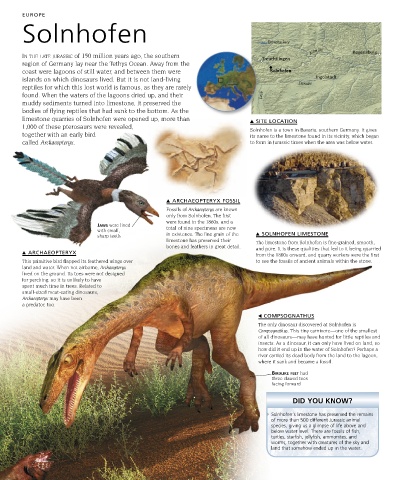
                                                            u ArCHAEopTErYX FoSSIL
                                                            Fossils of Archaeopteryx are known
                                                            only from Solnhofen. The first
                                                            were found in the 1860s, and a
                                    Jaws were lined         total of nine specimens are now
                                    with small,                                             u SoLNHoFEN LIMESToNE
                                    sharp teeth             in existence. The fine grain of the
                                                            limestone has preserved their   The limestone from Solnhofen is fine-grained, smooth,
                                                            bones and feathers in great detail.   and pure. It is these qualities that led to it being quarried
         u ArCHAEopTErYX                                                                    from the 1800s onward, and quarry workers were the first
         This primitive bird flapped its feathered wings over                               to see the fossils of ancient animals within the stone.
         land and water. When not airborne, Archaeopteryx
         lived on the ground. Its toes were not designed
         for perching, so it is unlikely to have
         spent much time in trees. Related to
         small-sized meat-eating dinosaurs,
         Archaeopteryx may have been
         a predator, too.

                                                                                             , CoMpSoGNATHuS
                                                                                             The only dinosaur discovered at Solnhofen is
                                                                                             Compsognathus. This tiny carnivore—one of the smallest
                                                                                             of all dinosaurs—may have hunted for little reptiles and
                                                                                             insects. As a dinosaur, it can only have lived on land, so
                                                                                             how did it end up in the water of Solnhofen? Perhaps a
                                                                                             river carried its dead body from the land to the lagoon,
                                                                                             where it sank and became a fossil.
                                                                                                  Birdlike feet had
                                                                                                  three clawed toes
                                                                                                  facing forward

                                                                                                         did you know?

                                                                                                . Solnhofen’s limestone has preserved the remains
                                                                                                  of more than 500 different Jurassic animal
                                                                                                  species, giving us a glimpse of life above and
                                                                                                  below water level. There are fossils of fish,
                                                                                                  turtles, starfish, jellyfish, ammonites, and
                                                                                                  worms, together with creatures of the sky and
                                                                                                  land that somehow ended up in the water.
   43   44   45   46   47   48   49   50   51   52   53