


Page 51 - DINOSOUR ATLAS
P. 51
EuropE
         Southern Britain                                                                              3#/4,!.$


                                                                                                                           /PSUI 4FB
         Early crEtacEous southErn britain was a vast floodplain that                        )2%,!.$
         extended south from where London is today, across to
         France and Belgium. Rivers and streams flowed down from                                                %.',!.$
         hills to the north, cutting their way through the plain,                                       7!,%3      ,ONDON
         filling lakes, then slowing as they reached a massive                                                   7EALDEN
                                                                                                                   'ROUP
         delta clogged with sediment. The ancient foothills of                                                                  "%,')5-
         London were clad with forests of conifers, monkey puzzle                           !4,!.4)#          )SLE OF
                                                                                             /#%!.
         trees, and cycads, and the floodplain was a scene of open                                            7IGHT         &2!.#%
         woodland and ferns. This was the home of Baryonyx, Neovenator,                  u SITE LoCATIoN
         and Iguanodon—a plant-eater who was discovered before the word                  Dinosaur fossils found in southern Britain occur within
         “dinosaur” was first used.                                                      deposits of Cretaceous sandstones, mudstones, clays, and
                                                                                         gravels. This material was formed 145–125 million years ago,
                                                                                         and is known as the Wealden Group.


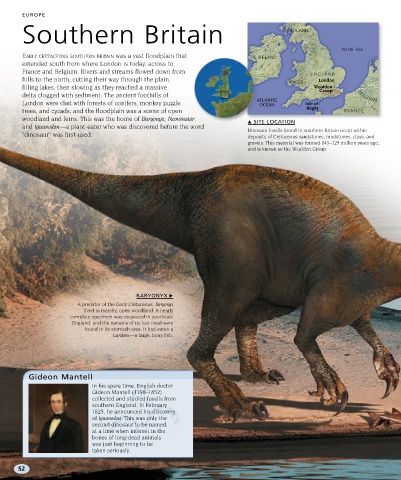
                                                  BArYoNYX .
                             A predator of the Early Cretaceous, Baryonyx
                               lived in marshy, open woodland. A nearly
                          complete specimen was excavated in southeast
                           England, and the remains of its last meal were
                               found in its stomach area. It had eaten a
                                         Lepidotes—a large, bony fish.


           Gideon Mantell
                                  In his spare time, English doctor
                                  Gideon Mantell (1790–1852)
                                  collected and studied fossils from
                                  southern England. In February
                                  1825, he announced his discovery
                                  of Iguanodon. This was only the
                                  second dinosaur to be named,
                                  at a time when interest in the
                                  bones of long-dead animals
                                  was just beginning to be
                                  taken seriously.


       52

